
 Apple Podcasts
 Spotify
 YouTube
 RSS Feed
 #243: CalSTRS & California DMV — Your Risk Is My Risk with Info-Tech Research Group
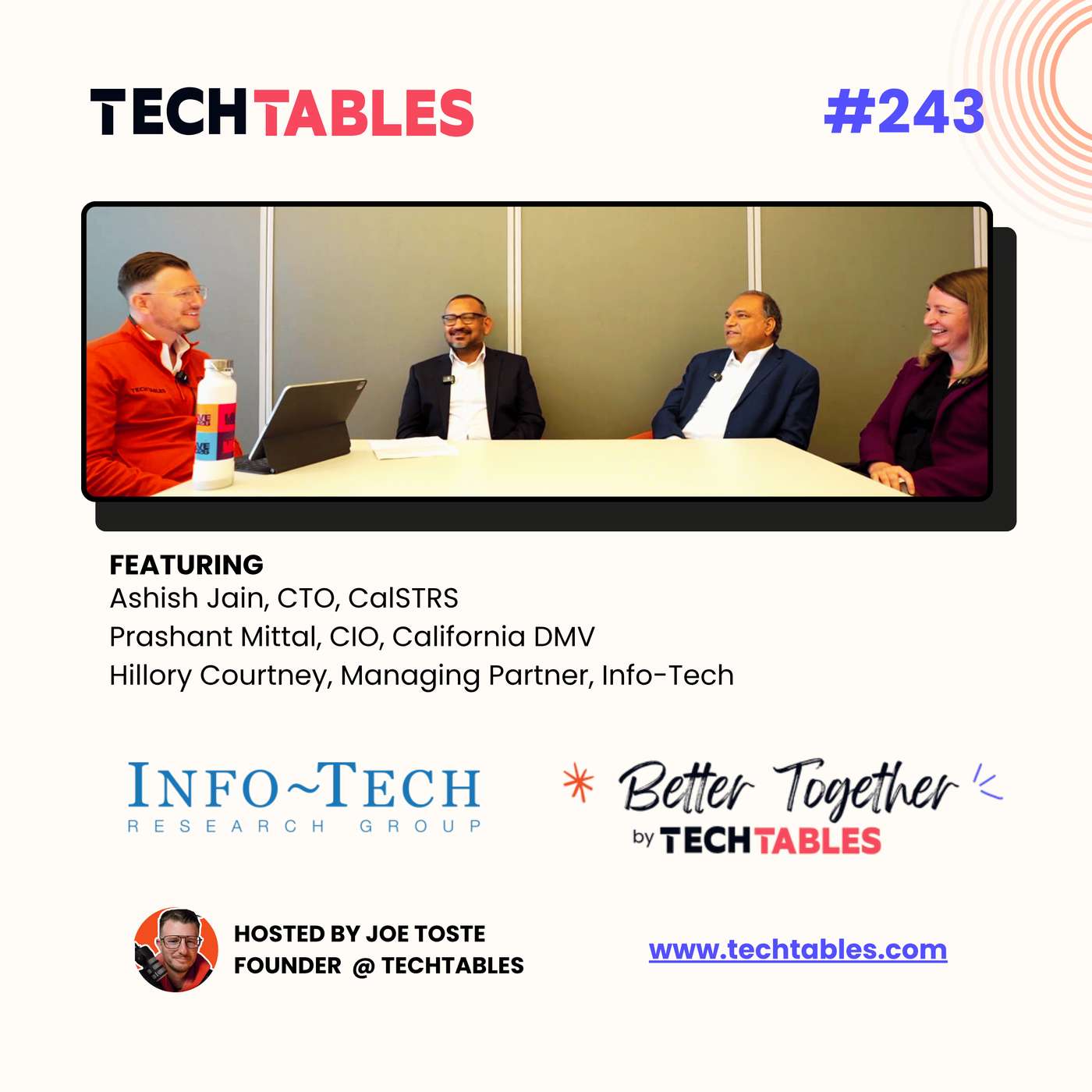
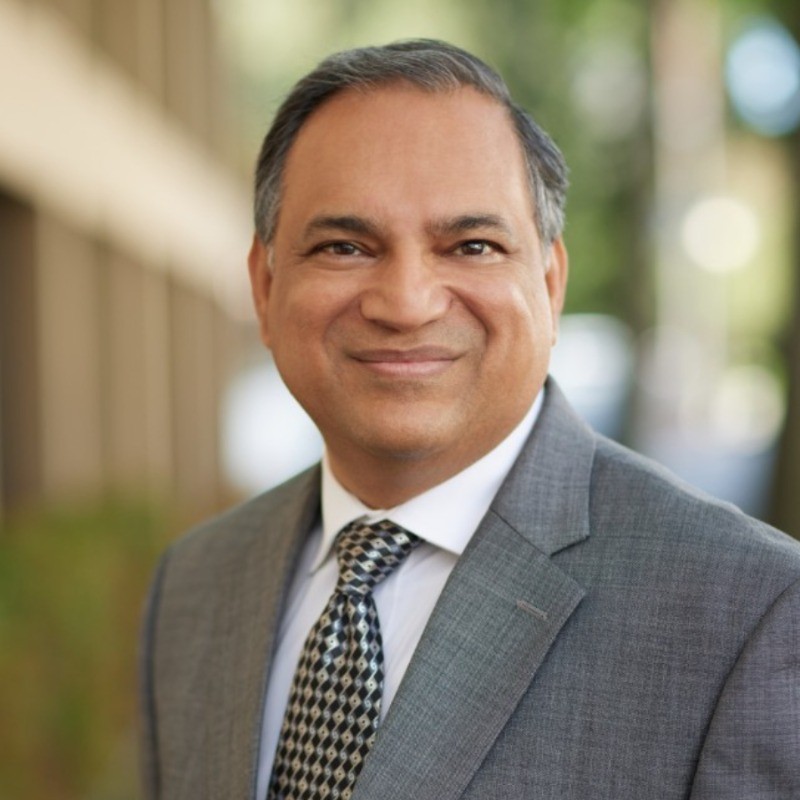
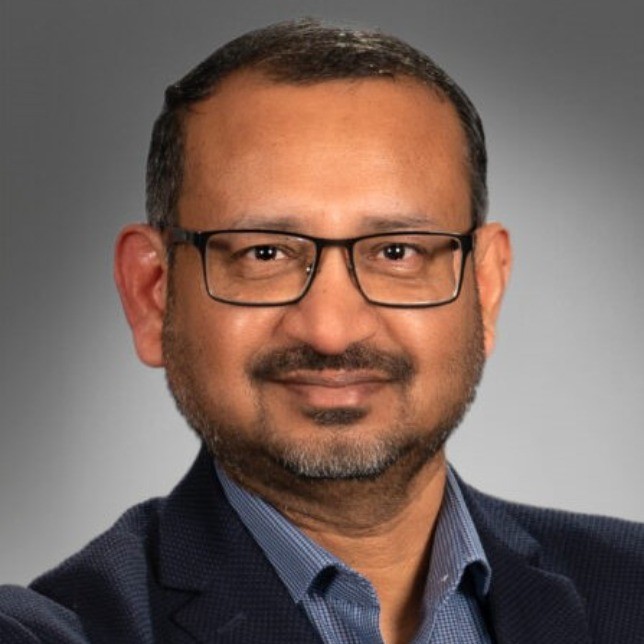
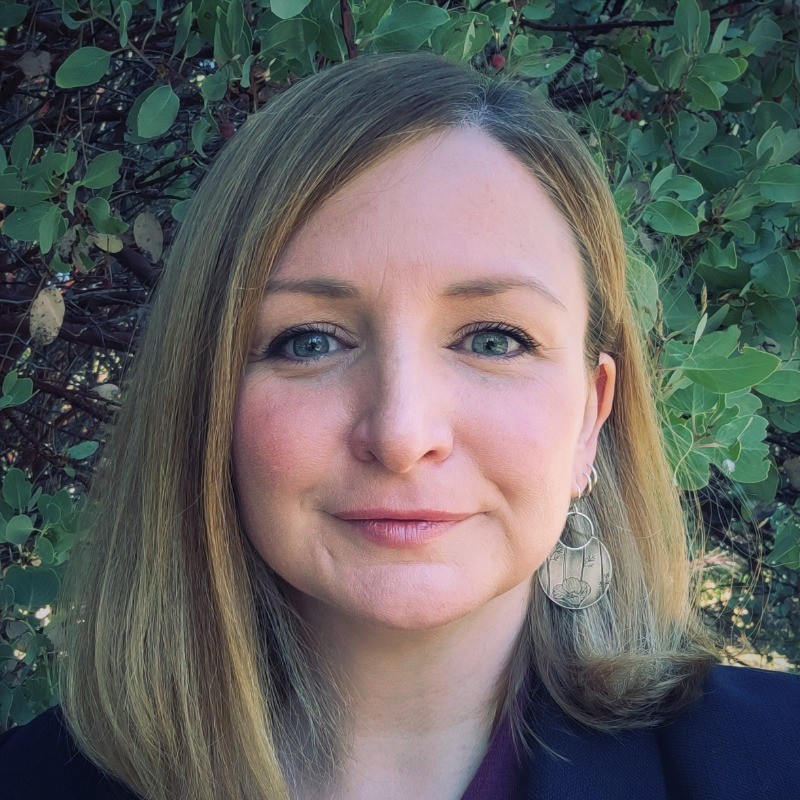
Recorded on-site at CalSTRS in West Sacramento, this episode brings together Ashish Jain (Chief Technology Officer, CalSTRS), Prashant Mittal (Chief Information Officer, California Department of Motor Vehicles), and Hillory Courtney (Managing Partner, Info-Tech Research Group). Ashish and Prashant go back to 1999. Prashant once reported to Ashish, and Ashish attended Prashant's wedding in India, although Prashant jokingly questions if that really happened.
Together with Hillory, the three share about how trust shapes every call they make, from DMV changing course on its modernization, to CalSTRS keeping AI out of decisions, to how Info-Tech helped them both turn ideas into action.
Guests:
Ashish Jain, Chief Technology Officer, CalSTRS
Prashant Mittal, Chief Information Officer, California Department of Motor Vehicles
Hillory Courtney, Managing Partner, Info-Tech Research Group
Timestamps:
0:00 Back at CalSTRS: the trust Prashant says bonded IT and business
2:25 Friends since 1999, and why that trust mattered when Prashant joined CalSTRS
9:09 "Your issues and your risk are my issue and my risk"
16:01 Wait for the business to ask, or act first? Prashant's five-minute pitch
26:03 Six weeks, 200-plus new hires, and the moment Prashant changed course
30:00 "I can't buy a tool and drop it on the table"
33:00 "AI is not making a decision for us"
51:20 Trust took years to build: why CalSTRS won't go all-AI with members
55:17 Different missions, 60 to 70% of the same problems: why agencies compare notes
57:09 "The idea is great, but now you have to operationalize it"
🎥 Upcoming Live Podcast Tours
1. 2026 IGNITE Powered by Info-Tech LIVE - Austin, TX - Sept. 17th-18th
If you’re an IT leader in Austin, Houston, or nearby, Info-Tech’s got complimentary tickets with your name on them (just DM me I’ll be there). IGNITE is getting past the AI hype and into the real questions CIOs are wrestling with: how to get your people actually using AI, what the shift from “employee in the loop” to “employee on the loop” looks like, and how to budget when the costs keep moving up.
→ Ready to join the conversation in person? Email joe@techtables.com
2. 2026 EDUCAUSE - Denver, CO - Sept. 30th - Oct. 1st
Returning for a third year in partnership with Carahsoft, and we could not be more excited. TechTables heads to Denver to celebrate the leaders, the stories, and the work shaping the future of higher education!
→ Ready to join the conversation in person? Email joe@techtables.com
3. 2026 TechTables Austin Live Podcast Tour - November 4th
We’re coming back to Texas for a live podcast stop in Austin, TX and we could not be more excited. TechTables heads to Austin to celebrate the leaders, the stories, and the work shaping the future of public sector!
→ Ready to join the conversation in person? Email joe@techtables.com
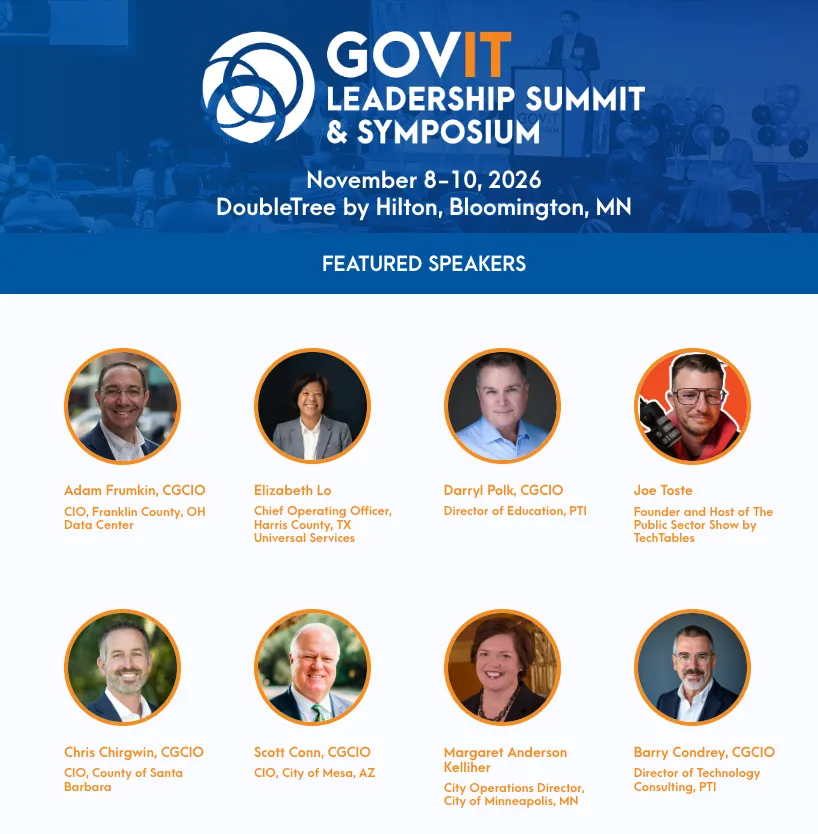
4. 2026 GOVIT Leadership Summit - Bloomington, MN - November 8th - 10th, 2026
We’re heading to the GOVIT Leadership Summit & Symposium in Bloomington, MN and we could not be more excited to celebrate the leaders, the stories, and the work shaping the future of public sector!
→ See the program & mainstage speakers: click here.
→ Attending? Let's record while you're there. Email: joe@techtables.com
Whenever you’re ready, there are 3 ways you can connect with TechTables:
1. 📬 The TechTables Newsletter
Thanks for reading TechTables! Get early access to new episodes, insights, upcoming events, and more — straight to your inbox.
2. 🤝 You shouldn't make the hardest calls alone.
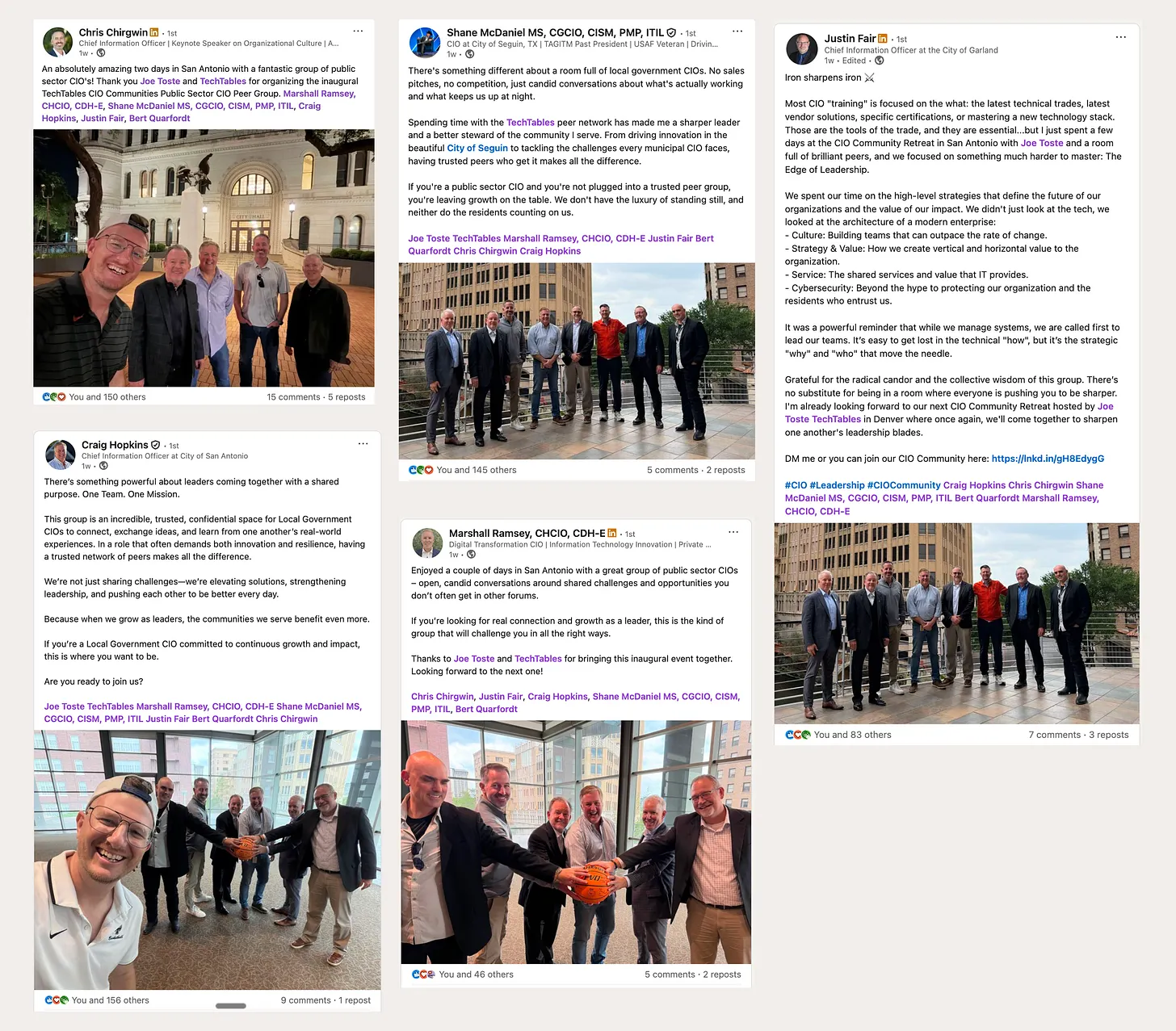
A peer advisory board of local government CIOs. Vendor-free, application only, twice a year in person — with 4x private forums in between.
See if you're a fit → https://techtables.com/communities-local-government
3. 🤝 The Better Together Series
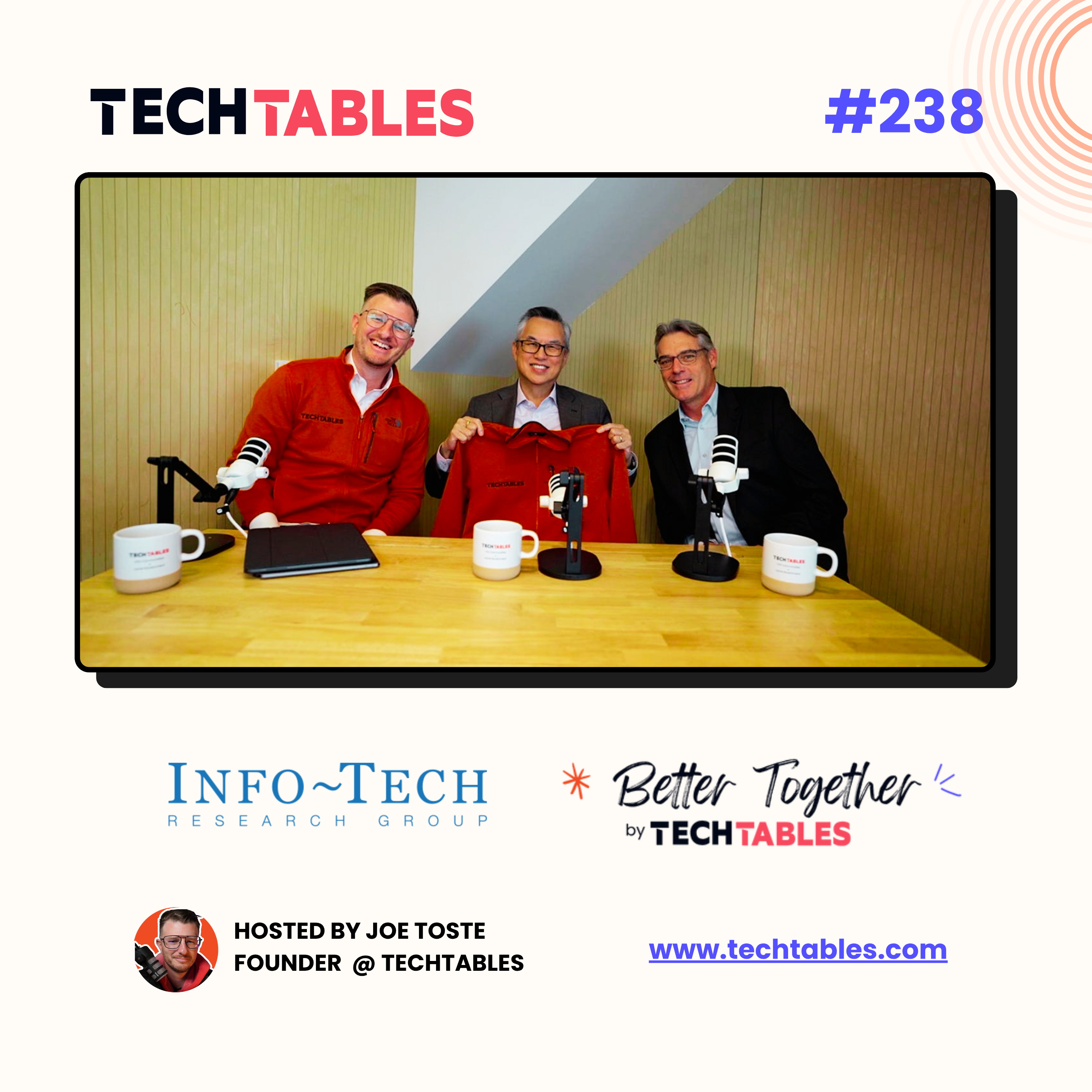
The narrative-driven series bringing together industry partners and public sector CXOs. Discover the compelling stories that unfold when we stop working in silos and start building together.
»»» Email joe@techtables.com to learn more.
[00:00:00] Joe Toste: Welcome to The Public Sector Show by TechTables. Super excited to have you all
In person at CalSTRS in West Sacramento. Prashant, for those who don't know you, give us a short intro.
[00:00:10] Prashant Mittal: Sure. Prashant Mittal, Chief Information Officer at California DMV. I'm with DMV for about four and a half years now. It's a amazing place, amazing work going on there and certainly a lot to share in our conversation today.
[00:00:24] Joe Toste: And what were you doing before the California DMV?
[00:00:27] Prashant Mittal: Before I was with CalSTRS, so I'm back to my home place. I was with CalSTRS for about eight years, and I was- Ashish was my boss when I was here. And I think together we have done some amazing work. It's basically, I would say the one thing if I remember out of our eight years journey is I think we did bring the I- IT and business together in terms of building the bonding and the trust among them, so we can do more wonderful things together.
So I would say that's probably the best part of being here.
[00:00:55] Joe Toste: Love it. Thank you for sharing that. And we're gonna jump into the relationship a little bit more in a second. [00:01:00] Ashish, for those who don't know you, short intro.
[00:01:01] Ashish Jain: Oh, I'm with CalSTRS nearing 13 years. I'm a member of the executive team. As CalSTRS, I started 2013.
Since then, I think I came in the right time, digital transformation and all is happening, so I just feel right time and the right place. Just like Prashant mentioned he was here with eight years at the time we started a modernizing journey for our pension administration, so he's the part of that journey.
Just last year we implemented that new pension administration and that was really is a big milestone for CalSTRS.
[00:01:36] Joe Toste: Love it. Hillory?
[00:01:37] Hillory Courtney: I'm Hillory Courtney. I'm a managing partner at Info-Tech Research Group. I love the work that we do there. My background prior to coming to Info-Tech, where we serve public sector CIOs and private sector CIOs has been in both private and public sector.
So I come up from a PMO background, and now I am lucky enough to be able to help fantastic leaders fulfill their mission and journey.
[00:01:59] Joe Toste: Love [00:02:00] that. Shout out to the Info-Tech water bottle- ... that I have. Got it at LIVE. Very intentional. I'm gonna just take a sip of water real quick. Yep. I love having fun, so hang, hang with me.
So Prashant you worked for Ashish- ...... at CalSTRS for eight years, so take us back. When did you meet? Describe, the relationship. Eight years is a long time. Did you cry when you left? Like, how did it... that's a long time for the two of you to work together. Tell us a little bit more about the relationship.
[00:02:25] Prashant Mittal: I'm gonna tell everything now. Yeah.
All right. So I know Ashish since 1999, almost 27 years now, so where we met, we used to work for the same private sector organization, and this where we met. I think we worked together maybe for two or three years out of that long duration of 15, 20 years in private sector.
And then what I also remember is he came to my marriage. I think it was way back in India, so he says he came there. I don't remember, though, so m- maybe I need to check the pictures now. So but, yeah, I know him since 1999. So [00:03:00] certainly a, a long relationship of knowing each other. And he joined the state in 2004.
- And I joined the state in 2011, so he actually convinced me to join the state. And and I joined CalSTRS in twen- 2014, so eight years. So I would say a pretty good relationship, but knowing each other helped me and I think him as well in getting the best out of each other. And when I joined CalSTRS, I would say the trust that I got from him and other leadership certainly enabled me to bring, I said, better bonding between the business and IT in general compared to how it was before.
So I think that, that important seed that we put on the ground, I think it is certainly paying the bills I, I hope for the CalSTRS organization now.
[00:03:40] Joe Toste: Yeah, and the reason I wanted to start with the relationship piece is when you don't have the relationship in any organization, it just leads to chaos, dysfunction.
I talk about... I coach high school basketball, I talk about this all the time on the podcast, but you can have the same team, but if they don't buy in, if everyone's not on the same page, it just results in turnovers- Yeah ... missed [00:04:00] opportunities. And so I love that there's this relationship here. Ashish, so you were at his wedding.
There's maybe some photos, maybe not. That's another podcast episode. I
[00:04:08] Ashish Jain: just went because of free lunch- ... at that time,
[00:04:10] Joe Toste: I think it's true. So that's so funny. So California DMV is probably more well-known, I feel like just across the state of California. Tell us a little bit more about CalSTRS, though, for those who don't know about CalSTRS, and then we can talk a little bit more about the relationship.
[00:04:22] Ashish Jain: So CalSTRS as we are the second-largest public educator fund.
We do the retirement security for our California public educators. For behind that mission, we have a very large, complex IT environment. So the IT we my team supports pension administration, financial systems, investment operations, data infrastructure. Now data and AI is a big thing.
Just like I mentioned to you that we just recently launched our new pension administration system. We were using a [00:05:00] mainframe , two decades old system. We replaced that one. We are going through the stabilization and improving the system as we go, as well as expanding our technology and infrastructure for now to make a room for AI and data.
So I think that's the, right now in the top of the mind and how we can pivot in a manner that the big system is now functioning, as well as how we will do this overall AI and how we'll make sure that our business user get the tools for their productivity and efficiency and the pain points we are seeing them to remove with AI and other technology transformation.
[00:05:41] Joe Toste: So let's talk about when you were at CalSTRS. Let's talk about some of the, the big projects at least before AI went mainstream. You were still at CalSTRS. And now we've have this kind of new era in the last four or five years. But what are some of the projects that you, the two of you worked on together, the complexity of those [00:06:00] projects?
Love to hear from the two of you.
[00:06:01] Prashant Mittal: Yeah. I would say I remember two, two main things I would say. One is, I think when I joined CalSTRS she certainly had a vision to bring some of the innovations in the organization, right? Rather than doing the things in a traditional way. So I think one of the role that I assumed here was was around bringing some innovations and transformations within the organization.
And once we had that in place, or the foundation was in place I was trusted to, lead the pension solution modernization at that time. So that was the largest modernization that, that I was asked to lead. And I left CalSTRS, but certainly the team carried forward that modernization, and they
were,
they went live.
So that's a big accomplishment that I feel proud to be associated with, in the time I was here. So I bring Prashant,
[00:06:43] Ashish Jain: Maybe he forgot about that one, why he came to the building. We bring him for technology renew.
[00:06:48] Prashant Mittal: Yeah.
[00:06:49] Ashish Jain: We were like digital transformation at the time, 2015, 2016. That was a big initiative for us and his first job to just to see that how we can bring the [00:07:00] latest and greatest digital transformation to our organization.
And then for some reason we found out that now we have a big, big project we had to kick off for the pension administration, and that's why he was the director over overseeing the pension administration project. The good thing I think he mentioned about the relationship he- you talk about only eight years.
I'm dealing with this guy for many years now, 25 to 27 years. I think the relationship- Happily,
[00:07:28] Prashant Mittal: though. Happily. Happily. Did you say?
[00:07:29] Ashish Jain: Yeah. Yeah.
[00:07:30] Prashant Mittal: Just making sure.
[00:07:31] Ashish Jain: Yeah. But I think the bottom line is he and I has a very one common mission how we can help our business side. I think we have a different way to do things.
But in the end of the day, we want if what efforts we will- we are doing to make our business can be nimble, more efficiently is there, productivity is there, or we are just not chasing for a shiny tool of an IT. I think there's [00:08:00] sometimes we have a tendency to just to run to the shiny tool, but that's not both of us.
I think that's the common thing, that we just try to understand from the business what the problem we're trying to solve, and the technology come later and then just see how we can solve it. So that's with Prashant, he's always there. He made me look good many times everywhere, so I can't complain.
[00:08:24] Prashant Mittal: I'm listening first time.
No, kidding. Yeah. One thing I would say that Ashish said, I do want to underscore, I think that's the common theme I find among two of us. We have been in IT all along, right? For 25, 26, 30 years. But while in IT, I think we are passionate about business. I think that's the biggest common theme that I think we saw in each other.
And if something makes sense for the business, we don't wait for business to tell to do it. We are just gonna be doing it just because it's the right thing to do. So I would say that common theme actually made it much easy for us to work together in terms of what we do part of IT organization.
[00:08:59] Joe Toste: [00:09:00] So the two of you have great alignment, and then I imagine because you both have bosses, they also bought into that vision-
[00:09:08] Ashish Jain: Oh, yeah
[00:09:08] Joe Toste: and mission, right?
[00:09:09] Ashish Jain: Oh, definitely. I think it's not like it's a we are in the same mindset and all. But the beauty of Prashant bring to the table, that he has a tendency to go to the peers. Even not in the peers, he can go one deep, lower, second deep, in their management, has a working relationship.
I still think that most of the time we just hung up with this technology, but technology is the little piece to it, but the relationship, the chemistry, and they open up. That if your issues and your risk are my issue and my risk, your pain is my pain, and it, that go a long way. So he build up that trust relationship.
I still think we have a right team at this moment. We are doing a pension administration stabilization and they are doing good. I have some, my direct reports working for me for 15 years and 17 years, so [00:10:00] we develop the leaders. But I just feel that how this chemistry among us as well as the other leaders with my boss the business side, how they have to trust.
And if the trust is built up, then things will go and fall into place. I think that's our mantra, and that's why we are successful.
[00:10:19] Joe Toste: Yeah. So I like what you said about, it's Not just about, A, the technology. It's also just not about, the two of you. There's a team, there's people.
There's probably project management, right? So yeah, Hillory, love to hear, from you. You've got your time at Placer County, and then which I'm sure was... I don't even know how long you were at Placer County. I think it was- Almost 10 years ... was it 10 years? Yeah. Yeah, almost 10. Okay, so you're at Placer County for 10 years.
That's a really great experience, and now you're also at Info-Tech and externally helping. And you were on the PMO side- ... which I have a lot of friends in public sector on the PMO side. It is a very complicated and I would say complex job [00:11:00] because it's not like you can just say "Oh, it's just like project management," right?
But no, there's so many, there's so many relationships. There's so many other different dynamics involved. There can even be politics involved getting the internal team together. And so yeah, love to hear, from you like how like internally, your time at Placer County and then now at Info-Tech, how you also help advise on that side.
[00:11:20] Hillory Courtney: I originally came to Placer County and actually worked in the county executive office. So I was part of their nascent team to do a full-scale ERP implementation. So as far as the hearts and the minds and the business-centric focus, I can't tell you how much I empathize with both of your stories in that space because I...
And I now in this role, since I've been at Info-Tech, help so many different IT leaders that are struggling through all different versions of, "The business doesn't listen to me," "The business throws it over the wall," "The business is my fantastic partner," "The business is secretly doing things that they don't tell me about," which is very frustrating as an IT leader.
[00:12:00] And that f- that focus on really the customer perspective first, but also where... we don't have jobs in IT if not for the business reasons for us being there. Yeah. And everything that we do in public sector is so satisfying because it actually is a public service for what we do in technology and IT, and that's what originally brought me to the county is because I wanted to do public service, and then I just moved to where I can help a bunch of other public sector IT leaders do what they are doing for service providership.
But it is crazy how much I watch leaders struggle to make those partnerships real. So I think it's, it really, again, resonates to see that your success stories are because you built those relationships one by one to make sure that the things that you were moving forward for technology initiatives were perfectly paired for what the business needs were.
And when you have strong sponsors that are engaged, it really helps us do our job in tech because we can't do it without them. And sometimes that can be not an adversarial, but just a really [00:13:00] challenging relationship to try and navigate.
[00:13:02] Joe Toste: I like the understanding of - Your business first, and then the IT piece second
[00:13:07] Ashish Jain: Is really is the business first. And I think what I tell our team, the technical, technology team, that we have to build up a trust relationship. Trust and the mission. We have to understand our mission, and if we are working with our business folks, how they will be successful what we are implementing.
I think in the end of the day we have to make sure that they will be successful, what kind of technology we are - putting together. So the trust, the transparency, and then on top of that one, the risk and issues.
[00:13:38] Barbara Zumwalt: Is
[00:13:38] Ashish Jain: all these projects is ... There is not any single project didn't goes out. They
You had to bring everybody together, and it's not your risk, it's your risk. Your risk is our risk- ... and how we are working, taking the accountability about that one, and share responsibility. It's not re- I don't want ... That's the [00:14:00] last thing that someone will feel from the business, "Oh, this is a IT project.
That's not a IT project. It's our project, and we are working together. And so the transparency, the trust, and understanding the business is really important.
[00:14:13] Joe Toste: How do you go about communicating that throughout the organization?
[00:14:17] Ashish Jain: So we have a very good communication team.
Is we shout out weekly basis if there's anything new is we are unveiling or we are going out we provide that one. We have a gamification sometimes we do to just to people can be excited about that one. Communication is very, is always challenging part. If you do more, then people just say, "Hey, it's too much going on."
If you do less, we are not aware of. So I think it's one thing in our favor in CalSTRS because we all are working together. So if you are hearing something in the different floor that we don't know about anything, about this project or something, we right away- Yeah ... just send out the feeler for that.
I think it... that's the beauty of our... that everybody [00:15:00] is the North Star is our mission, and everybody is behind that one. So even in any small project or big project, it just feel like everybody's pitching in. We're not just saying, "Okay, we're just discounting."
We take that one and just make sure that if we have to tighten our communication, so weekly communication, daily communication, monthly communication, q- quarterly communication, and we have a lot of avenues to do that. When we have a town halls, we have CEO and others go out, shout out for what's going on in the project as well as anything across the organization.
So we very much tied up about our communication in that manner. Feedback always come out. We are doing a little too much- ... little too little and all. So we just find the- And
[00:15:43] Hillory Courtney: you're doing the right amount ...
[00:15:44] Ashish Jain: the right amount. And sometimes it just feel like, okay, maybe our communication didn't land it up very well because it was not clear and all.
So we'll pivot. We don't have a finger pointing going on with something the other. So I think it's all about learning and pivot for how we can be a better version of our [00:16:00] communication style or something.
[00:16:01] Prashant Mittal: Yeah, I still remember one time when I was... it was example from CalSTRS. There was a meeting going on with our procurement team, right?
They were trying to bring a new process to be in better compliance, right? So on and so forth. And someone did a pretty good job in thinking through what that process is going to look like. And process was-- and I was part of one of those people who had to l- understand so we can be in compliance of it,
and presentation went fine, and I was wondering that what is being asked- is so manual where it's gonna take probably thousands of hours of people's time every month. Simple process, but since so many people are involved, it just don't make sense in today's world, right? So business didn't ask for automation, and I was thinking, "I don't wanna do this manually myself," right?
So I went to the business leader who was providing that, that presentation, and I said, " I think we can make it very simple if you let me talk through this," and then it was five-minute conversation. They liked the idea, and then when I came back, [00:17:00] my team was not happy, saying that they didn't ask for it, and you offered a solution. Now you're creating more work for us. So I think the... where I'm trying to go with this is sometimes it's about show and tell, are you going to do things when business ask you, or are you going to see the opportunities before you act on it, right?
So one was, yes, team may not be happy with me in the beginning, but I told them that it makes sense for 50 of you to do this manual work every day. Is it not better that we look smart in helping them automate it?" So I would say that was one show and tell example I remember very clearly in my days at CalSTRS.
The other thing that I see at DMV when it comes to the business and IT collaboration and how we communicate and how we show the importance of the relationship is our CEO at DMV, he expect IT to know business and business know, business to know IT. That's a common theme, right? Business leaders should have a reasonable understanding of what IT means, what IT possibilities are, and IT leaders must understand enough about business so that they can have a meaningful conversation.
So [00:18:00] that, I would say, expectation is really forcing us to get out of our comfort zone and l-learn about business. So I would say show and tell, and then having a more, more clear understanding of it is expected of you. It's not something you have to do by yourself. It is expected of you in your role to learn each of those domain.
I think those two things are certainly helping us go in the direction where I think we were about 10 years back.
[00:18:23] Joe Toste: So I think this is a very important piece because sometimes people miss this. Sometimes it's all of the very deep technical stuff. People, "Oh, Joe, talk about communication," and like it's a, "i heard that on the last episode." And I'm like, "You know- It's so important and constantly... there's a difference between going back to high school basketball. Barbara's gonna love this back here. There's a difference between the frosh-soph team, the JV team, and the varsity team, and do you know what the difference is?
Besides physical strength and they're a little bit older, there's one difference: communication. The varsity team is constantly talking. And they're constantly moving into the positions that they need to go. They're not [00:19:00] waiting for IT or the business. They're not waiting for the other players to get to their, just waiting for them to hang out in their spot.
They're constantly talking. And I realized, oh, you know what? This is just the same thing in organizations. If you can't... If you don't communicate, And I prefer to over-communicate. I know some people are like, "Oh, you're communicating too much." I prefer that you would over communicate, be crystal clear.
And so I think that's such an important piece. And then looking at, if you look at California DMV, yeah, the last X number of years, it's been awesome.
And we're gonna jump into the modernization and AI piece right now. I'm using DMV because I am a consumer. Everyone here is a consumer of services
and but for like California, it's been great to see the DMV. There used to be when I was a kid, you'd go to the DMV, wait in line, driver's license, the whole thing. And now there's DMV machines inside Albertsons- Yep ... which is awesome. That's how I get my re- tags, renewal tags. Whether it's online, you know what you can do online, how [00:20:00] you can do identity verification, how you can, I know it's probably still early, but I have the, Oh, so no one thinks I'm, I moved the whole table, as no one thinks I'm bluffing on camera right now as a California-
[00:20:12] Ashish Jain: You have motor deal? ...
[00:20:13] Joe Toste: citizen. I have got my mobile California driver's license. Woo-hoo.
[00:20:18] Ashish Jain: Good
[00:20:19] Joe Toste: job. Which I want to use that the next time at at the airport.
So yeah, if you're listening on audio, no one knows I just moved. But if you're on video, you fully realize I moved, hit the table, and yeah. But I love it because there's this blend between the physical and digital world, and I know that's the same is true with CalSTRS, right? Oh,
[00:20:34] Ashish Jain: yeah. Yeah. The modernization is for me we are in, obviously in technology space.
We just feel like replacing technology is a modernization. That's not the case, right? How we are changing our processes for better is a secure and is data improving the data of processes. The, I think is the perception out there that modernization means we have to replace everything in the technology sp- stack and bring [00:21:00] in new shiny tools.
And for us, if we just go back to technology is the last thing we touch the business problem, and in the during understanding about the problem, it's most of the time is about process. We have to improve our process, how we can improve our process. Is it's just working out for us. We have innovation kind of kickoff project per se, but whatever the idea is coming out, most of the idea is how we can enhance our existing process.
So I like it because I always just, the status quo is not me. We always just think whatever the decision I made five years back and now is totally different. So I always have that kind of in my DNA that how we can push or see the opportunity a little differently. And we were very successful, not because we are replacing the old technology, but we are changing the way we do the business, and the process is now coming out much better.
[00:21:58] Joe Toste: So
[00:21:59] Ashish Jain: that's, for me, is [00:22:00] modernization.
[00:22:00] Joe Toste: Love it. How do you define modernization?
[00:22:02] Ashish Jain: For us,
[00:22:03] Prashant Mittal: The, the focus of modernization is customer-centric for us. And by... But when I say customer-centric means that whenever we are doing a modernization, we are keeping the customer in mind and then working backward from that perspective to see what makes sense for a customer.
And yes, it can include lots of things. It could include things like we have to replace the legacy technology with a new one, and we have to refine our existing business process to make it more optimal. But all that towards making sure that the service for the customer get improved over time, right?
So I would say that's the basic definition of modernization for us. Certainly, as Ashish said, I agree that modernization is not to just replace old versus new technology. And one thing that, that I will say that we at DMV organization, I'm sure other organizations are doing the same thing too that there is a very deep interest by the DMV organization.
I know you said that maybe the experience you had five or 10 years back with the DMV versus what [00:23:00] you have now is hopefully better and different. And it's for, I would say, one main reason, I would say. And that main reason is that we are trying to understand what is not working well right now, right? We do have lots of processes, lots of policies out there, and if those policies are coming in the way from getting it...
getting better service to the customer, I think we are challenging those things to opt and making it optimized so that it makes sense for the customer. For example, there were over-implementations of a policy in in my example where people had to come in the field office to take the exams.
It's not needed in every case, so we read the policy again, and then we came up with a more sensible conclusion that only in certain cases you need to come in person to take the driving test in person, right? There is alternate available. You can learn online.
We are looking at what... how to make it easy for a customer. And if it means policy discussion needs to happen, we have a discussion. If it means we need to rip the current process and make it more optimal, we are [00:24:00] doing that. It means If the customer has to travel to come to the field office and we believe we can do it online, we are making that attempt.
So I would say i- if I travel from how it was five years back versus what it is now, a customer with appointment can come in and out within 15 minutes from the DMV field office. That's that's the time that we take. Rather some people say less than 10 minutes, less than seven or eight minutes, right?
So that wait time has reduced, and it is because we optimize processes. We have enabled better systems, more stable systems for the organization, and we are enabling more digital channels so that people don't have to come in the field office, and we have less traffic, foot traffic to deal with.
So I would say it's always customer focus. Rest is, we have to figure out what to do in order to make that work from that alliance.
[00:24:47] Joe Toste: Yeah. I think you guys have done a fantastic job in the last five years. It's easily noticeable as, from car registration and tags and, you name it.
Yeah, it's been pretty, pretty seamless. So I think, I've got some other friends who are [00:25:00] CIOs. I'm thinking of Wendy Baron at the Texas DMV, and so just all around the country, there's other CIOs who are at the DMV, and I'm always very curious to see, what are people working on.
I was thinking about the Arizona DMV. Just thinking about the different types of where are they in their modernization journey, what does it mean to them. I love the customer experience 'cause I think also it helps, not just someone like me, but it also puts less pressure in the field office- on the staff- Yeah ... 'cause they don't need to have these crazy lines. I love the digital component. I just... E- even looking on the, I was looking on the mobile driver's license just the other day, and I think there's s- there's such a great use case for that. And I, you think about someone like Hillory.
Hillory goes to a bar, right? And say she gets carded, and she pulls out what's on her driver's license? Yep. Her home address, right? And so now it's like they don't need to know. They just need to know that she's over 21. Correct. And so being able to, you can show now, I was looking, that they made, there was like an update- Yep
where, like you can show what you wanna show on there, which I was like- Exactly ... "Oh, this is pretty good, [00:26:00] actually." I th- that's one of my use cases that I like,
[00:26:01] Ashish Jain: Yeah, privacy is important.
[00:26:03] Joe Toste: Yeah,
[00:26:03] Barbara Zumwalt: Yeah. Yeah.
[00:26:03] Joe Toste: Yeah. Prashant, just to continue with you just a little bit take us back. You talked about how about nine months ago you took modernization back from a partner.
You hired 200-plus people. Walk us through that.
[00:26:14] Prashant Mittal: Yeah. So about, I think it was sometime in October last year or maybe nine months now- we took over the modernization from a vendor partner, and we took the responsibility of being the system integrator, put this way. And as most organization will do, we came up with a project plan.
We came up with a staffing plan of how long it will take and how many people we need. And we did hire 200 plus people from outside. Smart people, and all experienced people, of course. And when we got them on the ground to, to... and put to the work after about six weeks, we realized their productivity is not where we anticipated.
And we started wondering they are smart people. We picked them from the market, right? And why we are not able to make the progress that we anticipated. [00:27:00] They-- we had a inventory of about seven hundred defect/gaps that we were trying to address when we took over the modernization journey.
And their speed was they fixed around fifty defects in about six weeks. That was very slow. And if you go by that speed, this project was not gonna get done anytime soon, right? So that was the biggest setback we had, that something is not going as we expected So and then we said, "Okay, let's find out what's happening here underneath," right?
So the problem were not the people. People were experienced, knowledgeable, and they were willing to do the hard work. Where the struggle was that we inherited a system that was fragmented, right? It was too large for people to understand, so they were lost in figuring out what is the context they need to work within, what they need to do, how they will do.
So they were lost in that journey of figuring things out by themselves. So no fault of theirs. As a human, there [00:28:00] is only so much you can digest, and maybe we didn't anticipate that such a fragmented system we are going to inherit where things are going to be in silos altogether, right?
So that was the biggest realization that, okay, something didn't go as expected, and it's time to do something different. And I think that's where we actually introduced AI in our organization
[00:28:19] Joe Toste: You gotta give me more. We introduced AI Okay. And
[00:28:21] Prashant Mittal: now that you're tempted.
[00:28:22] Joe Toste: Yeah. So- He's fishing right there.
[00:28:23] Prashant Mittal: Yeah. So I said the, the biggest gap was that not everyone understood what we have inherited, so we wanted... And then they were siloed. The larger the organization is a common theme that the larger the organization you will see the more siloed teams in the organization, right?
A smaller team, -- silos are not going to be there as much. So we had data conversion team, we have the design team, development team, testing team, automation team, business team, you name it. All those good things that we have, right? But everyone had their own siloed knowledge, and that too fragmented knowledge around it.
So something had to be done, and then this where we thought about AI [00:29:00] is out there, so let's try AI. And we actually did some research about with various vendor partners and to figure out what's the best way we can use AI to solve this problem. And in that journey we were fortunate to have some, some vendor partners who had that expertise in being able to solve the problem that we were facing.
So if you go in the market, you will see lots of AI tools, and everyone is promising everything, right? But the real thing is can a technology and a tool solve the problem you are facing in your organization? And that's the best fit, right? In general. And so we got that in place and I called it a AI lab, so artificial intelligence lab.
And the whole intent of that was to accelerate our modernization journey. And initially, I have to say it was hard to have a buy-in from the team because it was new. It was new for me, too. No one was born with AI knowledge, right? We are learning all together ourselves. And there was a resistance for two reasons.
One was not sure if it is going to work, and second just you [00:30:00] are adding more thing in the plate for us to navigate with sort of thing, right? And this is where I realized that y- I just can't have-- I can't buy a tool and drop it on the table and hope it is gonna work for the organization. I actually personally led a model pod, model development pod, and just to make sure I see how effective it is and then adjust on the way so that we can make it fit for our organization, right?
So I carried model pod about w- with one architect and I think six or seven developers around it. We injected AI into it, I will join the call every day morning and in the morning and evening. And it started working. And the people who were not willing to come on board, actually, or those who were resisting, they are now curious to come can you help me now?"
sort of thing, right? So we came from the point of making it work and fit in the context that we were operating in, and then that, I would say, that goodness that it created within the, the model pod, [00:31:00] others were so excited. I'm stuck here. Now can you help me? I'm stuck in testing. Can you help me write test cases, or can you help me data conversion?"
Now, everyone who was not willing to be the partner is coming back to us saying that, "Can I be part of AI lab and get this benefit?" So I would say, to give you a contrast of thing, fifty defects were fixed in six weeks, and with AI, I think we fixed around four hundred and fifty in about eight weeks Again, the accuracy is great.
I would say it's not 100%, which is why we always have a human in the loop. So I think to me the theme is what would I have learned in this process is, as said, no one is born with a knowing how AI works. We have to learn, and we-- And unless we are part of journey, we are never going to learn ourself, right?
So be part of it, and it starts with the operational bottleneck. If you start by dropping a tool and let's say experiment with it, it can go only so far. So that we had a real problem, and we had a real solution, and this how I think everyone started loving and being part of their journey. So I would say now I [00:32:00] don't think any of us, including me, can imagine a life without AI.
It's amazing help, for the organization.
[00:32:06] Joe Toste: That's great. I also agree with you. I cannot imagine what my life would be like with- without it. Oh, wait, I can actually imagine. I did a whole tear down of my business when this started really coming up 'cause I'm like This is awesome. I gotta reimagine what this whole thing's gonna look like. Let's get CalSTRS in here. Okay.
Yeah, love to hear, w- where are you on your- ... your AI journey, and how are you helping to solve some of those operational bottlenecks that you have?
[00:32:27] Ashish Jain: So since ChatGPT came, our life is a little different, right? Everything is all revolved around AI. What we did in, We started off in CalSTRS, we created a policy first what we can do, what we can't do
We take very seriously about our reputation, and we don't want our members' data or any investment decision, people have a perception or something that we were going out. So what we did recently, the copilot, we give it to our teams. All the staff has the copilot. We also [00:33:00] go a little bit more about practical way of just going back to the philosophy
what is the business problem we're trying to solve? And now we just see if AI can help us. Just like Prashant is saying, that's 60 use-- 50 use cases in six weeks to 400 and something in eight weeks is, that's bigger, right? So we started off experimenting. We did some pilot and happy that we are now three or four things going into production.
One is our chat box we are taking our emails and some summaries. We are doing the vast area of documentation, how we can filter down for our investment staff. But it's again, always no members' data, and we are not making decision. AI is not making a decision for us.
Before we identify any tools to use this, we identify who is the owner in CalSTRS. They are accountable for that one. If just like accuracy in AI, it can be-- we have to identify what's working, [00:34:00] what's not working, and someone has to take that one. It's just not a given. So we didn't go with the automation Agentic no decision-making.
So far our testing team we also experimented with that one in the production, and we are seeing a good result out of that one. Productivity is also increased. The testers, we never, they never thought about some test cases when they were testing. Now with help of AI, they can be a little bit ahead in there.
So is we are seeing it's a The governance, what kind of guardrails, what kind of security. We ask those question upfront before we are approving what kind of guardrails we have, what kind of security, what kind of privacy and how we will be using that one. So I think it's that kind of framework is really helpful to us because now every tools we are bringing to the casters has some AI component to it.
And so we are asking the vendor how they will be using in how they're [00:35:00] training, how the data is going. So that is a lot of work for our enterprise architecture team, our ISO team, our legal team to be in sync to just to identify those kind of vulnerability if any, because vendor just give the demo and behind the scene AI powered, but what does that mean to us?
So we had to unpack that piece to understand we are just not moving forward blindly. And so we will have, the trust with the members and employers and all. So we take that one very seriously. Our governance is working out. We just going a top-down approach. Every time someone is asking for a new tool or something, it just came, they came to us.
We all looked at it. Came to us means executive team. We looked at it, we asked those kind of questions and our behind the scene, our team, the ISO, the legal enterprise architecture team, just see if that tool can be sustainable in the long run. [00:36:00] It just not looks like it's good on the surface, but can be sustained and maintained in the long run.
So I think that's we are doing currently.
[00:36:06] Joe Toste: I saw it's a very large tech company here in, in the Bay Area. Described it this way, said that they're talking about AI, and he goes, AI, I think about it in three different buckets.
The first bucket I think about it is like a Mercedes. You've got this Mercedes, and they just trying to bolt some AI into this. The second bucket is like Tesla, where, you're actively, through kind of brute force, just trying to train these models and trying to get the car, but it's still very much a human driving it.
And then you got Waymo. Mm-hmm. And also more of a brute force of just driving around and getting maps, and that's the autonomous first kind of piece of it. And so I think it's interesting to f- for on the vendor partner side is like I was thinking as you were talking what bucket?
A lot of vendors fall into the Mercedes bucket where-
[00:36:53] Ashish Jain: Oh, yeah. They just give a demo. It's just so unreal but we have to look day 10, not day one.
[00:36:58] Joe Toste: Yeah.
[00:36:58] Ashish Jain: Because it just... I [00:37:00] think that's very important that if everything looks, in the demo looks very promising, but you unpack that one, then you find out what kind of a skill set is needed, how you can support in the long run, if our overall roadmap is in there.
Because not all tools can work in our environment because we have a large technology portfolio. If you just say, "Hey, Google AI," we are not Google shop, right? So I think there are a few things you have to be consider before you make a pivot in any of the tools.
[00:37:30] Joe Toste: Yeah. So the two of you were at Info-Tech LIVE.
Which was great. Had a blast. It was awesome. I hosted the podcast there. We'll link to that playlist in the show notes once, once it's live. Also, I watched the NBA finals when I was there. That was really great. There was probably 30 people around me. I had my phone at the end of the night.
But I was thinking, I think it was maybe three days, and- ... the theme was, from hype to value. So you said you, you're not an agentic shop,
[00:37:56] Ashish Jain: no. We are experimenting.
[00:37:57] Joe Toste: Yeah.
[00:37:57] Ashish Jain: But I think as agentic people take a [00:38:00] little different flavor to it that maybe I can do 100%
Yeah
Automation, and we are very mindful of that one. We are not giving our decision-making outside of our staff, and they are accountable. We are accountable. At this moment, we are just looking some areas where we can go a little further, but we are not making just human in the l- middle, human in the loop, whatever analogy you will go.
But is some vendors pitching for that?
[00:38:29] Joe Toste: Yeah
[00:38:29] Ashish Jain: That you can just click this button, and your life will be easier. But we are seeing, let's say, lot of ad is happening, but the value, the hype is there.
[00:38:41] Prashant Mittal: Yeah.
[00:38:42] Ashish Jain: Is, and hype they have to do it. I get it, because they have to be surviving in this environment. If they're not talking about AI, we are not entertaining them, right?
Yeah. They-- That's the perception is there. So they are very compelled to pitch that idea, but those are still half-cooked ideas, and they are learning as we are learning. [00:39:00] I think we also found out when they promise that they can bring something, and we bring the team, and right away, as we are learning, they are also learning they don't have a ten years experience or twenty years experience.
This is so new to everyone. So if we are pushing the right issues like a business problem, and we are handling that business problem in a piecemeal approach, if one portion is done by AI, we're more than happy to take that one.
[00:39:29] Joe Toste: So I think, like, when, at at Info-Tech what I like is a lot of the folks there, , were CIOs and or a senior leader. And part of the job of a senior leader is to actually cast the vision also and be looking down the road. Can't just be heads down, dragged into the weeds of the day-to-day 'cause you have to be able to look to s- as much as you can, right?
What, what do the next five years look like? Quantum governance, I'm just making this up right now. Might not be, might not even be the most exciting thing on the planet. But at some point it's, things are gonna, things are [00:40:00] gonna change. And yeah, while you were there were there any use cases or ideas, anything that inspired you while you were at Info-Tech Live?
You're like maybe this is not here yet, but five years from now this is coming, or three years from now this is gonna be really great."
[00:40:14] Prashant Mittal: Yeah, I can probably share. I think there was a I I joined one of the, one of the vendor presentation actually when I was at Info-Tech event a couple of months back, and they were sharing a...
Again, it was all about AI. There was nothing without AI in Info-Tech, which, I can understand. But there was one particular demonstration by a vendor. They were talking about building a context a knowledge graph to feed into AI so the AI can make better decisions, right? Or AI can help you make better decisions about what you're trying to process, whatever you're trying to process in the organization.
And I found it... I heard of what that means in before I went there, but I think when that, when I saw the demo, I think it does made me understand that okay, world is, has already moved further along in [00:41:00] that direction than what I was hoping for. And it's such a coincidence that I was talking to one of the, one of the vendor partner a couple of days back in the organization.
And what I saw three months back I thi- seemed like world has already moved much farther in that area right now. So normally when you talk about AI, right? You talk about cloud, like LLM and all these things. Every such, I would say, LLM is helpful, but they are not 100% accurate. We all understand it, right?
Now, the... I think the world is moving towards finding a way to make it more deterministic, more accurate than it was before, right? One is, I would say even if it is 50% good enough, it is helpful to the organization anyway, right? But certainly, we need to get to the point of making that 50% accurate to, say, 70%, 80%, 90% of the time.
Now in the AI world, there are things happening where there is something that is going to fit on the top of LLM so that we can pass a more context-driven or right context or full context to the LLM so it can make better decision for [00:42:00] you. So I would say there was a realization that something more is happening in this AI world.
And when I spoke to the vendor partner a couple of days back, I realized It's actually happening. It has moved further along, and I think we are going to try that possibly in our organization because there is always a desire to be more and more accurate with the time. Yes, even if AI is 50% accurate, we are going to welcome it because it is helping us get better than what it is today, right?
But if AI is going to make it 70, 80% better, we are going to adopt even more and more. So I would say it does it did trigger some of the possibility when I was there about something is happening in this area, and now I'm seeing it, it has happened with some of the vendor partners over here. So certainly a realization that there is more than what you know is out there, and I think that's the purpose of conferences, when you j- join those sort of things.
[00:42:49] Joe Toste: Yeah, and some humans are only 50% accurate too, so I'm just saying.
[00:42:53] Prashant Mittal: Oh, 100%. 100%. I think one thing that, that I should say that I think now that we are talking about AI, so I would say [00:43:00] AI is just not about helping customers. We have to help ourselves so we can help customers better in general. So DMV is around 8,500 people organization, and a more than 50% of our staff is customer-facing, right?
Field office, call center, and all those sort of things. And a- as you could see, DMV is full of policies and processes, right? And sometime there is a policy and then someone is going to write a process around it, and then you will almost find multiple processes around it, and then you wonder which one is right, which one is wrong, right?
And think about what will happen to the new employee that you're hiring, how he's going to figure out which one is right, which one is wrong, right? There's lots of time investment that goes in figuring things out. Yeah. So we actually and we are a situation where customers are in the field office, they are on the phone, they are in the live chat, and they are looking for information.
And our goal always is, has been, and will remain to provide the most accurate and quick information back to the customer, right? So if people are not well informed, they're likely going to [00:44:00] make mistakes in giving the information back. So the fragmented information, again, the moment you see the word fragmented, I think about, I think AI can help, number one to me.
So we introduce a AI-assisted solution within the organization, and our frontline staff can interact with that solution to get a clarity on a topic that customer is seeking help with. And that internal solution is getting 40,000 hits or questions every month, and it is almost 90% accurate. So think about it that how accurate and how quick we are providing services back to the customer and how well we are able to operate in a fragmented environment that used to exist for last 50, 60 years in the organization.
So I would say amazing use case that can really be a game changer right now. Even with less than 100% accuracy, it's a blessing to try that in your environment and see where you can bring the goodness out on the table.
[00:44:54] Ashish Jain: So for me, the Info-Tech or any conferences, I just look for two or [00:45:00] three, areas.
It's a good thing that when we go to the conferences, like Prashant was this time was there, but someone else the staff, we d- do the divide and conquer c- because the conference is two and a half days. So many topics, so many parallel topics going on. We try to learn everything. For me, this time is about, this AI hype is there.
Everything is related to AI, right? So the agent of AI and the concept they explain and they demo it, that now if you have a 10 AI agent working, but someone has to watch that agent.
[00:45:35] Prashant Mittal: Yeah.
[00:45:36] Ashish Jain: And then on top of that you have just like a hierarchy in our estate and any organization you have, you are creating like 10 agent for developer, 10 agent for tester, then 10 agents for senior testers.
So that is a good concept because now this agent if something is agent is not very typical simple AI, they're learning with each other. If they're [00:46:00] learning, the AI is learning the bad stuff, they can exponentially go bizarre, right? So how we can just make sure that we have a another agent watching to that agent.
So it just- Not doing bad things. ... it, that you are in your lane because that sometimes now you're hearing, I think at that the concept in the conference. But now you're seeing lately Anthropic and all, the agent just took over. Yeah. And go to the, it just ignore the others. So others, whatever the guardrails they were having.
So I think this is a bigger curve ball. It's a large curve ball is coming in our way, that how we can have that agent in their lane. So that's a, another for me I came back and I ask our team that what kind of guardrails we are putting together if it's something is behavior is changing- because it's a every day they are learning with each, each other, and how we are backing up that one because that's also, it's disaster recovery and all is [00:47:00] a big part of us, and how we will back it up our agent when the, if yesterday they were learning something this and now it's different. So it, this is a really totally different ballgame, and we have to take a thoughtful approach about it.
It just not we have to move fast because everybody's moving fast. We have to take a pause and sometime we have to ask the question is this really needed at this moment, or we will just see, how the people are doing that one. The conference was great.
I learned quite a bit. The context, just like I think Prashant mentioned, that's also very practical way of how you are training your models.
[00:47:37] Joe Toste: This is a whole other podcast. I'll have to have you come back- ... because this is actually very fascinating. In the Wall Street Journal there's a couple articles recently about whether ChatGPT or Claude or one of their models, escaping
[00:47:48] Ashish Jain: and just like- Yeah, that's a real problem.
[00:47:50] Joe Toste: Yeah.
[00:47:50] Ashish Jain: How... We, because we did never think about that one a month or two months back. Yeah.
[00:47:54] Joe Toste: Yeah.
[00:47:54] Ashish Jain: Now they are going, changing the lane by own, and who is watching that? And now I'm seeing [00:48:00] another issue, what Prashant is just saying that they are doing quite a bit. They are producing the code.
AI is producing the code, and code is a millions of line code. How the human can validate that code, right? So i- it just is just amplifying the problem if we don't take a thoughtful approach. That, okay, this is again, is going back to the, our old days when someone is writing the code, someone is reviewing the code, the quality check.
But how you can do the quality check of million lines i- in seconds, right? Is coming out. So we had to think a different way to do our quality, do our testing, do our security, but these are the question, the privacy, the security, the legal consequences.
If sensitive data is out how we are protecting that one, because trust is so important for us. We just don't want to open the flood gate and then we'll say, "We'll figure it out."
[00:48:55] Joe Toste: Yeah. No, it's a, those are, there are a lot of great points there. That's definitely a separate [00:49:00] episode.
E- even I have this problem where sometimes With Claude,
...
[00:49:03] Joe Toste: It talks back to me, and I'm thinking, "Dude, have some humility." What? No way. You're telling me? And so I love the agent checking on the agent. And then, it's, again, it's a whole other podcast episode- Yeah ... but it would be a great one especially as things are developing and and only getting faster.
But those guardrails are super important. The privacy's important. Yeah. The security is super important. Security. Very important. Your does your agent get a passkey? Who decides? Does it authorize itself? Is it a super admin? There's all these crazy questions- Yeah ... that I have.
[00:49:31] Ashish Jain: So we very much is everything. We don't go to public domain. Our, all the LLMs is private network, so we're not exposing anything outside because we have a lot of trust in our members and employers and investment and all, yeah.
[00:49:49] Prashant Mittal: I think I would say that some of these stories Look is scary, right?
Oh my God, what will happen if everything get ... I hope we don't get scared enough not to try. I think we got to try because [00:50:00] as, as I said earlier I think we need to stop fighting or resisting use of AI in our life, right? And we just need to find a way to create a version that is safe in our environment.
Of course- Yeah ... privacy data is important, but I hope these stories are not stopping us from-
[00:50:14] Ashish Jain: Oh, definitely. We are
[00:50:15] Prashant Mittal: not
[00:50:15] Ashish Jain: stopping ...
[00:50:16] Prashant Mittal: looking
[00:50:16] Ashish Jain: towards- I think we
[00:50:16] Prashant Mittal: are ... improving things in our organizations. Yeah. Yeah.
[00:50:17] Ashish Jain: So Prashant, I think the, the message is just not, we have at least 70, 80 different use cases.
Yeah. So is I think is we can't stop, but we have to just look if we are just talking about our members' data. Yeah. If we are- Yeah ... we have to make a decision- Of course ... based on what AI is producing to make our trades or something. We have to think about that one. So- Yeah. Agree ... I think we can provide some data in front of our staff to make a decision, but we are not there that, okay, we can make a decision through AI, right?
So- Yeah ... that's a big difference.
[00:50:51] Joe Toste: I think I just take it more just like a, I don't know if it's like just an awareness, I think is more of what it is. But and on the curve of like early adopter to late [00:51:00] adopter, I'm on the early adopter side, so I get it.
[00:51:02] Ashish Jain: No, we are also.
Everyone is- Yeah. Yeah ... I think is a-
[00:51:03] Joe Toste: Yeah ...
[00:51:03] Ashish Jain: we are not putting our gas on the pedal, but is again, we are taking a thoughtful approach. It's just not everything, whatever we are seeing is to try out. Yeah. I think that's a maybe we- A-
[00:51:14] Joe Toste: and you have to at scale. Yes. It's just the reality. I can do basically whatever I want as one person shop, but -
[00:51:20] Ashish Jain: Yeah.
And we have- Yeah ... 500,000 active users-
[00:51:24] Joe Toste: Yeah ...
[00:51:24] Ashish Jain: members and beneficiary. We can't just play around with that. So we have a trust, and we built it, and the trust is taking long time to build. Yeah. We build up. We have a reputation is so is there. We don't want to jump in and just say, "No, now everything, contact center is all AI."
We can't do that.
[00:51:41] Joe Toste: Yeah. Yeah. Yeah. That's good to think, it's good to think through all those.
[00:51:43] Ashish Jain: Yeah.
[00:51:44] Joe Toste: So I kinda wanna turn the corner as we start to, to wrap up the podcast. I'd love to talk about the partnership piece. I don't even know 'cause I didn't ask before, but I probably should've asked before.
But so are you both Info-Tech customers?
Yes.
Okay. Both Info-Tech customers. I'd love to hear how long you've been an Info-Tech customer, when did that [00:52:00] happen? Kinda walk us through the journey of the, the value that you see in a partner.
[00:52:04] Prashant Mittal: I will let you start because he's the oldest customer.
[00:52:06] Ashish Jain: No, he's not that old.
[00:52:07] Prashant Mittal: Not from the age perspective, from the relationship perspective.
[00:52:10] Ashish Jain: No I think it's we are a Info-Tech customer for last three years. The partnership, what I'm just seeing that we are learning. They are research organization. They are just going out, meeting with lot of CIOs, a lot of practical use cases.
What they're bringing to the table, I'm in CalSTRS. I have my network, but my network is still a small network. But I'm seeing the research, what is going on around us to just to see if we can take that one and make our team better. I think we are the opportunity. If someone is using not AI, some other tool, some process improvement, we're doing a totally different thing.
We are doing a workshop for softer skills, come on, that's not a, a AI or anything, and that is very relevant for us because we [00:53:00] know sometimes with the hard technology skills take you here to there, but you have to have all the soft skills will make you a better person, better leader and all.
So we are partnering with Info-Tech and bringing them for seven workshops for all the managers. So it's just not the technology piece, but how we can have a well-rounded leaders, well-rounded technology leaders. Where is the issues if you will go with this lane? What kind of governance looks like?
Because there are so many flavors to it. Some flavors will work in our environment, some flavors would not work in our environment. So we had to take the cherry-picking. In the end lot of just like I mentioned earlier, there are a lot of shiny tools out there. Our job, my job and my enterprise architecture team job is to identify which tool will work in the long run, which tool we can maintain in the long run, what value we're getting out of [00:54:00] it.
Some vendors, they're not happy with us because they just feel "Oh, why we're not taking that one?" And some it's just like what the value proposition, ROI, what the benefits we'll be getting out. So I think Info-Tech is a, is providing that one. I met... I have a executive partner periodically talk to her and then we come up a, "Okay, what's going on?
Is anything I need to other than Prashant or CalPERS or some area which I know well?" We can just make a connection and then just talk about if it's working out for them. I think that's also a, a good networking to understand if something is in Texas working, just like you mentioned. And the Texas teachers is doing few things.
In some area they are ahead of us, in some area we are ahead of them. So how we can compare notes and just find out what are the lesson learned and how you can do. So we use Info-Tech or some other research companies to provide that kind of context
[00:54:56] Prashant Mittal: Yeah. I think fortunately or unfortunately, we are the same ExcoDay [00:55:00] partner-
in, in Info-Tech.
[00:55:01] Joe Toste: Is that... That's Katie?
[00:55:02] Prashant Mittal: Yeah. It's
[00:55:02] Hillory Courtney: Katie. Katie, you were supposed to be here.
[00:55:04] Joe Toste: Yeah, that's
[00:55:04] Prashant Mittal: Katie. Katie.
[00:55:05] Ashish Jain: Yeah.
[00:55:06] Joe Toste: I love Hillory. Yeah. I've seen Hillory, but- Katie. Then,
[00:55:08] Hillory Courtney: so- She's here in spirit.
[00:55:09] Joe Toste: Okay.
[00:55:10] Ashish Jain: Yeah. No it's all about the relationship, and then- Yeah ... it's all about if you are seeing something is successful in some area.
[00:55:16] Joe Toste: Yeah.
[00:55:17] Ashish Jain: Because 60 to 70% of our common issues are- Yes ... very common. We are agency, bigger, different mission, different everything, but the back end office and others, they are 50 to 70% is the same kind of environment we deal with.
[00:55:32] Prashant Mittal: Yeah. So I was in a call with Katie and some of the analysts, I think it was about two, three weeks back on some of the customer service dashboard or analytics sort of thing, and pretty, pretty good demo actually.
So we are taking a deeper dive with Info-Tech to understand what that means. And then, I worked with CalSTRS, so I was telling Katie did you speak to Ashish? I think he may be interested." So I think just knowing each other and knowing the organization and where the needs might be, I think it's certainly a, a helpful bridge, I would say, as [00:56:00] Katie is common so I think he knows- Yeah
half of DMV, and I think I know half of CalSTRS- ... in a way, right? So I think we probably understand that what may help each other as well. So great partnership. I think one thing that I would say, for that, I think in, in today's world I would say it is, I think two things are important, right?
You got to have right strategy, but you should be able to execute on that strategy as well, right? So those two things are a must-have for you to be successful. And I would say the partnership val- that I value is more around that being able to navigate at both levels, not only just talk at a strategy level, but also to see how do we enable that strategy to get on the ground in working journal.
Okay.
[00:56:38] Joe Toste: Hillory when you meet with, whether it's new clients or existing clients or Ashish and Prashant how do you work, on, Do is it the executive partners roll up to you? I can't remember. Is that the-
[00:56:49] Hillory Courtney: Yeah, the executive counselors are reporting to me for state and local government in the West.
[00:56:53] Joe Toste: Okay. Yeah, so te- tell us more about how you work with them. There are a lot of Info-Tech fans listening, and some folks [00:57:00] who also, they wanna... They always wanna ask me, but I don't have the time to talk. I can't talk to thousands of people every day who wanna know more kind of about Info-Tech, how they help serve their customers and clients.
[00:57:09] Hillory Courtney: I was an Info-Tech member before I came to work for Info-Tech, so I have been on the other side of that particular conversation. Oh. Coincidentally, I also worked with Katie. So my my role and what I see us doing just really and what brought me to this work, and I think a lot of my colleagues as well, is we're solution engineering partners.
So we're here to act as really powerful force multipliers for agencies and organizations, particularly in public sector, where you can't necessarily have niche help who is a data architect and who is in business continuity and disaster recovery and artificial intelligence agent development, all of these different specialization areas.
And for me , my favorite part of the conference is actually after the conference where we come back, and you have ideas. And we figure out okay, what's the brass tacks of how we actually move forward with them? Because the idea is great, but now you have to [00:58:00] operationalize it. And so one of the things that's been so satisfying to see in this work is working with agencies of all different maturity levels at all different stages in their journey.
All of us are trying to navigate the challenges of what AI means in public sector and public service as technology leaders, as people who are responsible for teams. How do we upskill people so they know what to do, and they have space to be able to learn? And I have seen what we do be a really fantastic support to organizations at any scale who are looking to figure out how to do this and how to navigate it.
And so I take great pride in what we do, and I am so delighted to be able to spend some time with you guys today because it's fun to hear what's going on really at the grassroots level and to see how we are supporting what we have going on. So it just... It really is, for organizations that are trying to figure out, like, how, like, how do I move as fast as I possibly can within my budget constraints, my political constraints, all those different things, that is where we really [00:59:00] bring fantastic value to help you navigate that and really deliver on what your organizational priorities are so you serve the business,
[00:59:06] Joe Toste: i, so I, one of my favorite things about this past LIVE was that I got to see people who I saw around the country. "Joe, I s- you, you were in Florida and I saw you," or I'm thinking about Paul Manson, "You c- came to Louisiana." It was awesome. He was there. And so you kinda start to see everybody.
But then also on the CxO side it's just crazy to start to think about all of the different relationships. . But I think going back to serving the business, I think that's probably the best common theme for long-serving- CIOs.... I think you're probably gonna have a short stint if you're just all over the place and not focused on serving the business.
'Cause if you're serving the business, then they're gonna look good. And and you're actually gonna get stuff done. You talked about there's a strategy piece, and you need the right strategy, and then you talked about the execution. And which I think is where it all kinda comes down to it, right?
It's like, can you execute? [01:00:00] Can you put the ball in the hoop, so to speak? Can you just go make it happen? And it's been fun as part of my partnership with Info-Tech to... i've been telling a lot of these, these stories all around, whether it was the, You had a great episode with the state CIO in Nevada- Yeah
covering their the cybersecurity attack last year. Yes. Maybe not so great for Nevada, but it was...
[01:00:18] Ashish Jain: no I know the guy because we met in the Info-Tech, yeah. And so I can see... I can feel for him.
[01:00:23] Hillory Courtney: Yeah.
[01:00:24] Ashish Jain: But his, ransomware is not that easy.
[01:00:26] Joe Toste: Yeah. And so it's just, it's been, and I was down in LA County with Peter Loo, and they could be a state agency, LA County's so large. And so kinda hearing his challenges. And they have 40 different CIOs there. And so there are, I think what I found is a lot more similarities in CI- like you kinda nailed it.
Probably 70, 80%, right? And then there's probably that last 20%- Yeah. Yeah ... that's kinda edge cases. I really appreciate the time. I know we went over. I know we went over, Barbara, but I just- It was so great. It was so fun. And I don't do three-hour podcasts, but I probably could with y'all as we could start to [01:01:00] get more and more out of it.
But thank you for coming on the show. I really appreciate it. Thank you.
[01:01:03] Ashish Jain: Oh, thank you. Thanks. Thanks for having us. Yeah.