
 Apple Podcasts
 Spotify
 YouTube
 RSS Feed
 #241: Pilots De-Risk AI — They Don't Scale It | City of Avondale & Polimorphic

Earlier this year I sat down at the inaugural WRITA spring conference with Jeff Scheetz (CIO, City of Avondale) and Zach Duguid (AI Engineering Manager, Polimorphic).
Jeff's answer to what he'd put in front of a room of local government CIOs isn't a success story.
It's the horror stories — the scary stuff nobody puts in the press release.
Most of this episode is the unglamorous work that prevents it. Zach walked through what Polimorphic does before an agent ever answers a resident: a Knowledge Base Health Check that seeds up to 500 questions against a city's own content, then reruns them weekly or monthly to confirm what the agent answers and which sources it pulled from.
We also talked about:
Why pilots de-risk AI and then stall before they scale across departments
Single sign-on inside the city, four or five logins outside it
Jeff's next 18 months: consolidate, standardize, clean up after the growth
Timestamps
01:55 "I just got a new dog. How do I register him?" — the AI answers, then files the form
03:43 "We're not selling services. There's no checkout cart." So what is a city website for?
04:55 The caller doesn't know the address. They know the coffee shop. The map does the rest.
07:24 A water outage in Utah, live on the phone line the moment staff post it
09:14 Single sign-on inside the city. 4-5 logins outside it. Nobody's solved this.
10:22 30-40 departments, each with its own process — and the war against too many toggles
11:47 19 years in: how much security pain can you inflict before staff route around you?
12:56 "We had to move very quickly for years. Now we finally get to go clean it up."
14:14 Your chatbot is quoting agenda minutes from a decade ago — the check that catches it first
16:30 A 20-year employee retires. Where does the knowledge go, and can AI hold it?
18:18 Pilots de-risk AI. They don't scale it. Why Zach wants it treated as infrastructure.
19:28 Jeff's ask for the roundtable: not the AI wins, the horror stories
🎥 Upcoming Live Podcast Tours
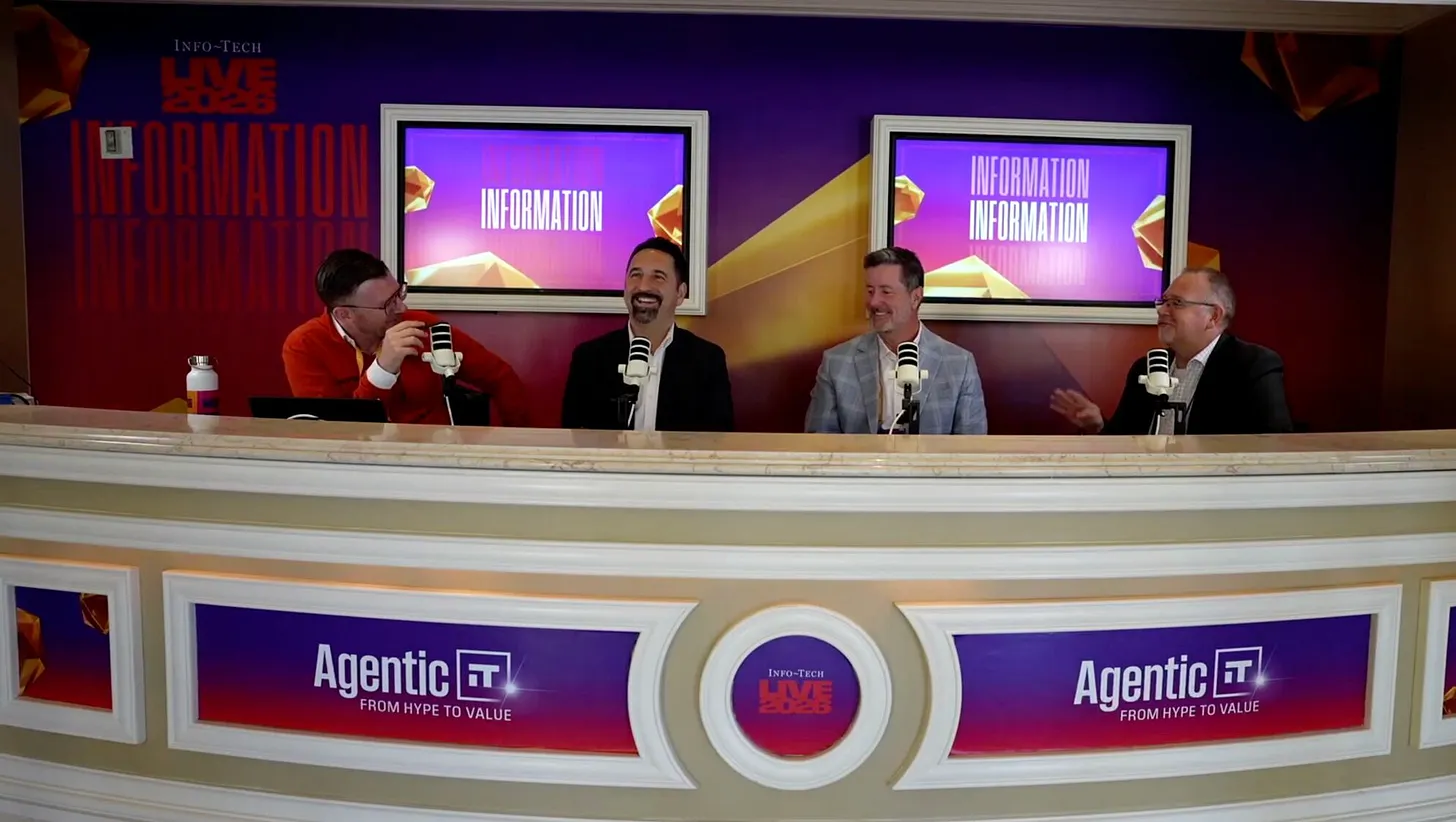
1. 2026 IGNITE Powered by Info-Tech LIVE - Austin, TX - Sept. 17th-18th
If you’re an IT leader in Austin, Houston, or nearby, Info-Tech’s got complimentary tickets with your name on them (just DM me I’ll be there). IGNITE is getting past the AI hype and into the real questions CIOs are wrestling with: how to get your people actually using AI, what the shift from “employee in the loop” to “employee on the loop” looks like, and how to budget when the costs keep moving up.
→ Ready to join the conversation in person? Email joe@techtables.com
2. 2026 EDUCAUSE - Denver, CO - Sept. 30th - Oct. 1st
Returning for a third year in partnership with Carahsoft, and we could not be more excited. TechTables heads to Denver to celebrate the leaders, the stories, and the work shaping the future of higher education!
→ Ready to join the conversation in person? Email joe@techtables.com
3. 2026 TechTables Austin Live Podcast Tour - November 4th
We’re coming back to Texas for a live podcast stop in Austin, TX and we could not be more excited. TechTables heads to Austin to celebrate the leaders, the stories, and the work shaping the future of public sector!
→ Ready to join the conversation in person? Email joe@techtables.com

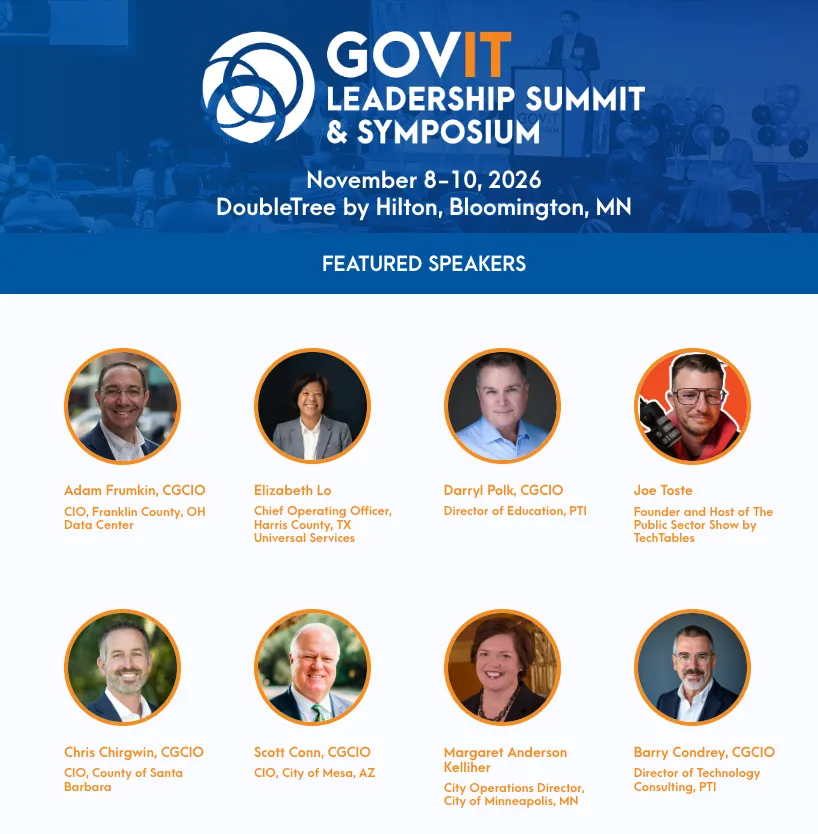
4. 2026 GOVIT Leadership Summit - Bloomington, MN - November 8th - 10th, 2026
We’re heading to the GOVIT Leadership Summit & Symposium in Bloomington, MN and we could not be more excited to celebrate the leaders, the stories, and the work shaping the future of public sector!
→ See the program & mainstage speakers: click here.
→ Attending? Let's record while you're there. Email: joe@techtables.com
Whenever you’re ready, there are 3 ways you can connect with TechTables:
1. 📬 The TechTables Newsletter
Thanks for reading TechTables! Get early access to new episodes, insights, upcoming events, and more — straight to your inbox.
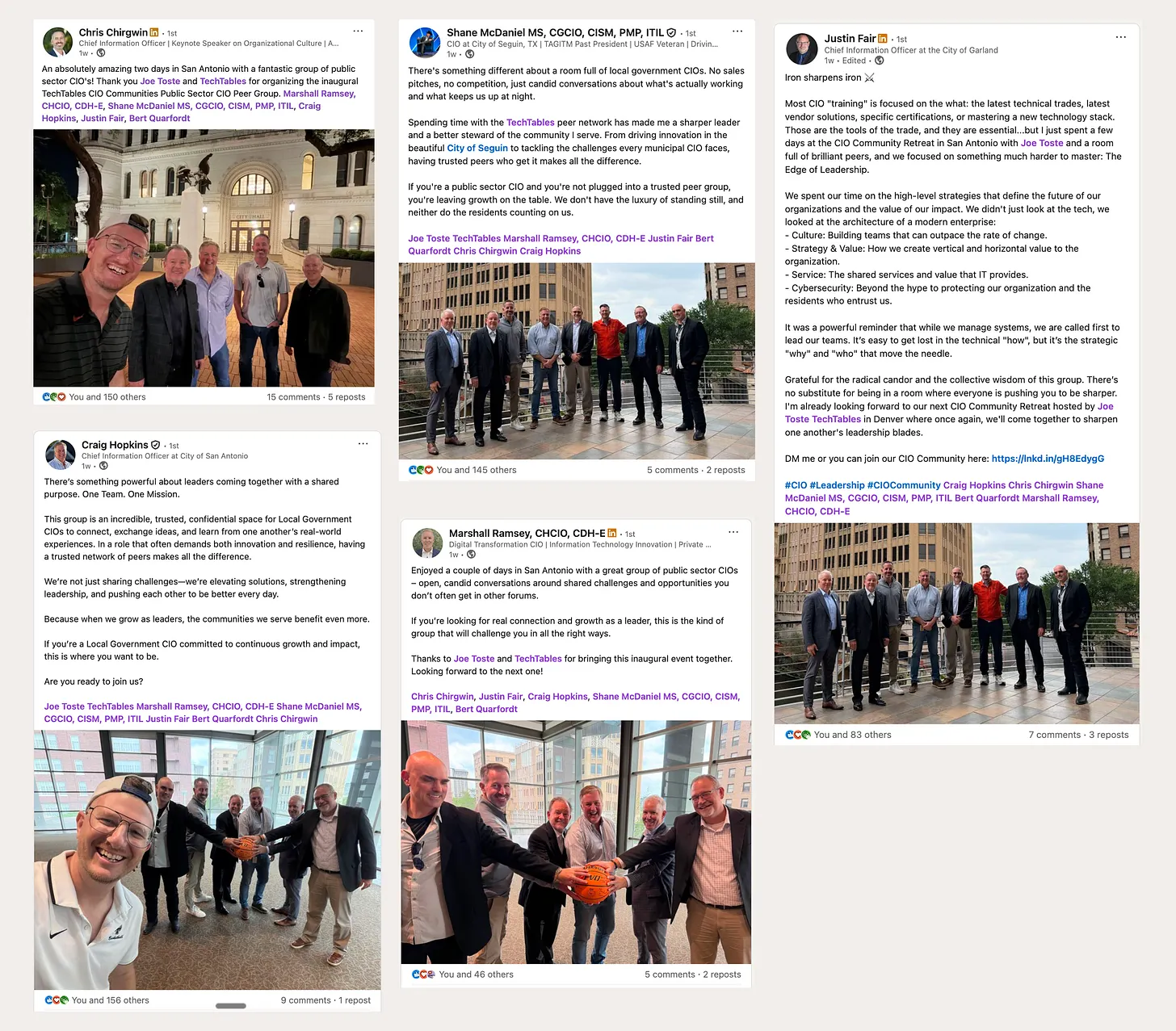
2. 🤝 You shouldn't make the hardest calls alone.
A peer advisory board of local government CIOs. Vendor-free, application only, twice a year in person — with 4x private forums in between.
See if you're a fit → https://techtables.com/communities-local-government
3. 🤝 The Better Together Series
The narrative-driven series bringing together industry partners and public sector CXOs. Discover the compelling stories that unfold when we stop working in silos and start building together.
»»» Email joe@techtables.com to learn more.
[00:00:00] Joe Toste: Welcome to the TechTables podcast. Super excited to have you both on the show both first time.
[00:00:06] Jeff Scheetz: Yes. First time.
[00:00:07] Joe Toste: Jeff, for those who don't know you, give us a quick intro.
[00:00:09] Jeff Scheetz: Jeff Sheets. CIO for the city of Avondale here, just west of Phoenix.
[00:00:13] Joe Toste: And do you remember the first time you came across TechTables?
[00:00:15] Jeff Scheetz: Oh, it's been years ago. Various conferences, especially on LinkedIn. Follow- Big Follower on LinkedIn.
It's been great.
[00:00:21] Joe Toste: Love it. Zach.
[00:00:22] Zach Duguid: Hey, I'm Zach. I am an engineering manager at Polimorphic. At Polimorphic, we're building an AI platform to help governments with service delivery and improving experience for residents and staff.
[00:00:33] Joe Toste: Love it. Shout out to Polimorphic. They've been on the pod from Raleigh to Miami in between and now in Arizona.
I love it. I love it. Jeff, we didn't get a chance to meet before and so it's almost like we're gonna do the podcast intro and the podcast and all in one. All in one. That's great. Give us the 30,000 foot overview of the city. What where's the city at and what do you care about and what are you really trying to push forward?
[00:00:57] Jeff Scheetz: Yeah. I think from a city standpoint, we're really [00:01:00] growing as I know a lot of municipalities are here in the Arizona area and but really we're really growing economically. We've got a lot of new businesses coming in, a lot of large scale businesses coming in. We're getting ready to develop a tech center in Avondale that's just been announced.
A couple big hotels coming in. Data center. So we're really doing a lot more from a city standpoint from an economic development standpoint, bringing in a lot that way.
[00:01:23] Joe Toste: And kinda curious around, from the IT perspective, with the city. What fires you up? Is it leadership?
Is it culture? Is it, data lakes? I don't know.
[00:01:33] Jeff Scheetz: Really the strategy and the planning. What's, like, where are we headed, right? And how do we get there? I think that's always been something I've really enjoyed is really looking at this, Hey, in three years we gotta bring on this AI tool, whatever, whatever it is.
And try to be, not maybe the first one, but let's be right at the beginning of all that when it comes into play.
[00:01:49] Joe Toste: So Zach, give us a little bit more about what Polimorphic is working on specifically in local government.
[00:01:55] Zach Duguid: I'd say there's we think about it, there's two major components of the product.
We have a [00:02:00] more staffer facing side of the product, which is your CRM and your workflows. So can configure stuff. Hey, this is how you get a pet license or a file for a building permit, et cetera. And then we have the more constituent facing side of the product as well. And that's where you have multiple channels that constituents can plug into, ask questions about the organization.
So that could be your chat bot, your voice line, SMS line. And then you can actually ask about those same processes that the CRM half has. So for example, you could call in and say, Hey, I just got a new dog. I'm new to the city. How can I register them? And then that AI agent can then walk you through that process and submit the form.
[00:02:35] Joe Toste: So Zach, I'm curious do you have some customer examples, like top of mind that you're actively using this for? What does it look like? Do they go to a website? Are they calling in? Give us a little bit more?
[00:02:45] Zach Duguid: A hundred percent. I think both. A lot of times you'll integrate with both layers there.
Oftentimes we'll be working with customers after hours as a easy way to start testing out the phone system, and then you can even take voicemails as well, and that can create a case for you in that internal CRM [00:03:00] system, so then staffers can follow up afterwards. Yeah, on the chat side, often it's, it you get embedded directly on the websites, either as like a search bar type of feature or a chat bot.
[00:03:09] Joe Toste: So this is pretty interesting 'cause I was talking to Richard McHattie about what is like the future and even like the purpose of a website for local governments. 'Cause you've got the traditional; I am both a consumer as a resident, in my case, Santa Barbara, California. But I also own a business and so I have to consume services, the state and various other areas as a business owner.
And a lot of times there's a lot of digging on the website, whether, it's the city or the county or whatever. And Jeff, yeah, I'd love to hear maybe what's your vision? Where do you see, I've never even been to the City of Avondale's website, but now I want, actually, I'm gonna do this in real time here.
Go check
[00:03:42] Jeff Scheetz: it out.
[00:03:43] Joe Toste: I'm gonna do that right now on the podcast. But yeah, I'd love to hear from you, just how do you think about citizen services, digital services? What's your view on that?
[00:03:51] Jeff Scheetz: Yeah, I think, it is interesting from a city, from a government website, right? Because we're not sell necessarily selling services like a typical business where you've gotta have a checkout [00:04:00] cart and all that sort of thing, right?
We don't offer those kind of services, but a lot of our services, I say our website is two facing, so part of it's there for the citizens to get information on the city, what we're doing, what's going on, what's, really, that kind of thing. Some of our biggest uses are maps, right? That is a big IT feature.
And we really have a lot going on with our maps from a standpoint of the citizen can look up what's going on in this corner, what's going on in my neighborhood from a development standpoint, right? Really, you see what, what's coming? So I think that's part of it. And then the other part of it is those citizens are doing business with the city.
So of course you've gotta pay your utility bill, that sort of thing, right? But then what kind of recreation activities are going on? What are the hours of the pool? And then how do I get a special event permit? I wanna host a event,
[00:04:42] Joe Toste: a podcast.
[00:04:43] Jeff Scheetz: Yeah. I wanna do a podcast in the city. What do I need to do for that?
That kind of thing. And really making those services very readily available for the citizen.
[00:04:50] Joe Toste: So you said maps, so if we unpack that. So we got GIS
[00:04:54] Jeff Scheetz: Yes.
[00:04:54] Joe Toste: Tell us a little bit more about that.
[00:04:55] Jeff Scheetz: Yeah, so we've got a great GIS team in Avondale.
And so we've. Develop, maps for the [00:05:00] citizens to use. So if there's a, an emergency going on in an area, they know where, evacuation routes are, all that kind of thing. So they're, we have that set up. They're working really closely with our emergency management. Of course, our maps are tied in with public safety from both a police and a fire standpoint.
Our police officers can get a call and, sometimes as a resident, you don't know the address, it's this coffee shop and so they can type in the coffee shop's name and know how to get there, and that kind of thing. All from within their CAD systems within the city.
So done a lot there. Doing a lot more in the area of digital twin. That's a big area right now in, the city government. And so starting to do more and more in the digital twin area to really visualize the 3D structures, what that's gonna look like.
[00:05:37] Joe Toste: Who's your GIS manager, by the way?
[00:05:39] Jeff Scheetz: So Harley Maniago. Okay. And he's been at the city for. 19 years I think.
[00:05:43] Joe Toste: Okay. Doing
[00:05:44] Jeff Scheetz: GIS the whole time.
[00:05:45] Joe Toste: We might have to have him on the podcast. 'cause I'm talking about I was just texting with Kacie Baker. Shout out to Kacie. She's at Maricopa County.
[00:05:51] Jeff Scheetz: Okay, very
[00:05:51] Joe Toste: good. She's their enterprise, GIS leader.
And she is gonna come to my event that's coming up. Next month. And but she was like, Hey can we meet virtually to [00:06:00] prep for our podcast? I was like, do I have an offer for you? I'm actually in Arizona right now. Nice. It's great. Yeah. So we're gonna grab coffee. She was like, are you just gonna stay in Mesa or are you gonna cruise around?
I'm gonna cruise around. Don't worry. Starting on Wednesday. Zach, I'd love to hear a little bit more about, Polimorphic GIS. I know you guys are reaching into that area. Give us a little more.
[00:06:17] Zach Duguid: Hundred percent. Yeah. I love that you brought up GIS and Digital twin. That's a super exciting area from our perspective as well.
Basically, our goal is to try to empower residents through those different channels that I mentioned before to. Dig into those data sets that you guys are curating and making available, and basically make it searchable from any of those channels. So if you were to call in and ask about, Hey, this is an emergency, there's a water issue, or I need to evacuate, where do I go?
And then the agent would recognize that as a GIS question based on the layers that were integrated with the system. And then just ask the user, Hey, what's your address? So I can give you information specific to you, do a geo location step and then feed the answer right back. And I think it's especially pertinent for situations like that where you [00:07:00] really need that information quickly and keeping it up to date.
And so we can plug in directly to whatever GIS server you guys might be using to get that information real time. So I think the realtime use cases are really
exciting.
[00:07:10] Zach Duguid: And again, a really rich data set to plug into.
[00:07:12] Joe Toste: So do you have a specific example? I know I'm putting you on the spot. A specific example, and I know it'll be a real example because you're an engineer and not a sales rep.
Give us a real example of a real customer.
[00:07:24] Zach Duguid: Totally. We work with Weber Basin Water Conservancy in Utah. They have a really cool realtime data use. So if there's a water outage in your area or Hey, what's my secondary water use? That's one that we support.
So again, real time data set, where as, as soon as a water outage occurs, they can update it on their server and then immediately all input channels like chatbot search, a voice will all have that data read at its fingertips. Yeah.
[00:07:48] Joe Toste: So curious, where are you most bullish on resident services right now?
It's constantly changing. Like Gen AI wasn't a thing just until, mainstream, at least for a couple years ago. But yeah, I'd love to hear like, where are you most bullish [00:08:00] and excited about?
[00:08:00] Jeff Scheetz: I think AI, of course is going to really change how we interact with the residents, right?
Because today, even if you go to any city website, you've gotta figure out, I've worked a couple different cities over the course of my career and everybody has it structured a little bit different, right? So as an employee of the city, you understand. I gotta go to this department for my building permit.
It's a little bit different over in this city may not be in the same department. So from a resident standpoint they may not know where to go for those kind of things. And so I think that's where AI, the chat bots or just AI in general that's gonna, Hey, how do I get, what do I find a building permit?
And I shouldn't have to know how to navigate the website, just gonna pull it up right there for me. That kind of thing. So I really see that change in the interaction with the citizens in the near future. It's already here. And so now we've just gotta get all the websites and the AI integrated everywhere to make that happen.
But I think that's gonna change websites for city government for sure.
[00:08:48] Joe Toste: So this would be a much longer podcast, like it would be like a two hour podcast. But I think something that's come up is, there are so many layers from integration to identity. To, in the different, even within [00:09:00] like Santa Barbara, there's like several Joe Tostes running around, not to mention the federal government and the state.
[00:09:05] Jeff Scheetz: Yes.
[00:09:05] Joe Toste: So yeah, I guess how are you thinking about identity management and like making sure that, everything is integrated. It sounds basic, but actually it's complex.
[00:09:14] Jeff Scheetz: No, it is, and that's something that I've wanted for years, but it's how do you implement it, I think is a question.
Within, within organizations, we all have single sign on, right? You sign in one account, you can get every app application you want, but it from a citizen standpoint or even from a business standpoint, you don't have that. Every business website you go to, it's a different login. It's the same thing within a city or county website because you have four or five different products to log into.
And so trying to couple those together is always the challenge, and I think that's something that's, we've gotta figure how to address soon.
[00:09:40] Joe Toste: Zach, so just to piggyback on that, I'd love to hear about how you're thinking about shared infrastructure and, the identity piece is gonna be, it's gonna have to be integrated into that, right?
[00:09:50] Zach Duguid: Absolutely. Yeah. It's a great question. I think somewhat similar answer to Jeff, I'd say, From the staffer side, we can leverage the single sign on or SSO in most cases. On the constituent side, it's a [00:10:00] bit trickier. Often it will depend on what type of data we're trying to get to. And then what type of user data is attached to maybe that data set that they can help validate against?
Different external APIs might have certain requirements like, Hey, you need to say your name, and date of birth or name and last four digits of SSN. So you need to be flexible with those types of authentications before you can like unlock. Or call those APIs with that user's data.
[00:10:22] Joe Toste: Can you talk about, this is just, I'm just kinda curious about this, but specifically around like the CRM case management in public sector.
It's, there's often, gosh, like 30 or 40 different departments, you got like parks and rec and all this stuff a lot of times. How is Polimorphic thinking about solving that? Like it's integrated into everything.
[00:10:43] Zach Duguid: Yeah, we're trying to make the platform as flexible and configurable as possible.
So at a base level, it's a very flexible form builder basically to accommodate any process from payments to identity inputs text inputs, uploading files, signatures, et cetera. And then we can [00:11:00] also add different connection blocks to other external systems in case you need to, when I submit this form, I need to generate a PDF and get that sent out to some other system.
For bookkeeping or recordkeeping. So we try to connect an arbitrary amount of external integrations as well. And so I think, yeah, the name of the game is try to make it as easy to do that without overburdening the UI and having too many buttons. We always joke at Polimorphic, we're trying to have the war against too many toggles in the app, trying to make it flexible design, but also not overwhelming from the staffer side.
[00:11:28] Joe Toste: Jeff just wanted to jump back. We haven't had the chance to really dive in. It's my secret sauce, so gotta do this. But yeah I'd love to just to know, I saw that you've been on a couple podcasts recently. Didn't get a chance to watch them, but yeah, I was like curious what did you get to share? Why did you like sharing that? Give us, like the secondary and, tertiary layers.
[00:11:47] Jeff Scheetz: I think being in local government for 19 years total between Arizona and Colorado. One of the things I really like doing is I mentioned that strategy, right?
How do we get IT to the next step? What's gonna make it better for the city? And and a lot of times we're seen as [00:12:00] that internal service and so really how do we keep IT, how do we keep the city moving forward? But from when you talk security, we can't inflict too much pain to either the citizen or to the staff members, right?
But yet we've gotta find that right balance, I think is everything. There's so many applications out there today. Even as you mentioned, CRM, there's 30, 40 of 'em, right? In all their departments. And how do you keep all these things going together and how do we tie everything together?
And I think that's the challenge is that it's something new every day. There's just something constantly exciting.
[00:12:28] Joe Toste: So we are, I don't even know what month we're I Look at my watch. I took it off to charge. That's so funny. So we're coming up almost, it's almost May 2026.
It could be the roadmap, but it could also be the vision of what does the rest of the year look like? What does 2027 look like? How do you also juggle the tension of things are just changing really fast? Yeah.
Sure I'm the CIO, cool. Tomorrow there can be a whole nother thing that's just gonna totally disrupt how citizens wanna consume services, residents wanna consume services.
Not that you're a forecaster, but what does it look like for the next, 18 months? How are you seeing the roadmap develop?
[00:12:56] Jeff Scheetz: I really I think for us I see it really to [00:13:00] try to consolidate as much as we can. Our services, our IT services try to consolidate and standardize. So we, over the years we've had these years of rapid growth.
You gotta respond very quickly to the departments, to the citizens to get things done. So now I think over the next couple years, 18 months, like you mentioned, I think we'll get the opportunity to go back and clean some of those things up that we've had to move very quickly on. We'll actually have time to get some of those things done.
I think we're gonna do some application consolidations as well along the way which again, we'll provide a better experience for both the citizens and our staff members.
[00:13:31] Joe Toste: I love that. So Zach, when, we talk about application consolidation. I was gonna use the word modernization, what's funny about that is I just had a podcast with the CIO for the city of Boston.
He, right before the podcast, it was pretty funny. He put out, I don't really like that term modernization kind of gets overused. And then I had Dell on that podcast and they were talking about modernization and I was like, oh hey. Lemme just save you real quick. And but it was actually, it was good 'cause it actually broke the ice and they were able to have a real conversation around, that, that fact.
[00:14:00] I'm just guessing, Zach, this sounds great, right? We all want, we want AI, we want it now. And faster and cheaper and better and all that kind of stuff, but there's just a lot of legacy applications. How do you help clients get over that hump?
[00:14:14] Zach Duguid: Yeah. One interesting thing that we've seen is the knowledge base accumulated by organizations will ebb and flow and grow over the years and decades. And oftentimes AI agents that are, powered by some kind of crawler ingestion system that can go through the website and the content to understand what that knowledge is, then you start surfacing maybe outdated or conflicting information which is pretty interesting, where maybe a user just searching the web might not actually end up on that page.
So right now, an interesting part of our strategy is how can we turn that into a more analytical approach before going live with constituents calling in or chatting in. And we refer to that as the knowledge base health check. So you have these recurring questions that. You and your staff could curate to help validate, Hey, what questions can we answer right now?
What sources are they [00:15:00] pulling from, making sure it's current and not these old agenda meeting minutes from a decade ago, right? Because we don't wanna be, answering with stuff like that for the general user question, and then that gets run on a, weekly, monthly cadence to help verify, okay, this is our agent's health.
It's answering questions that we want, deflecting other questions that we don't want. But yeah, it's interesting. I think. So I guess the, to sum that up, I think it's adding an analytics layer and monitoring layer on top of the agent to make sure it's abiding by the goals of the organization.
[00:15:28] Joe Toste: So give us a little bit more.
[00:15:30] Zach Duguid: Yeah.
[00:15:30] Joe Toste: So you said a lot there, like on, on the back end of that. How do you actually implement that?
[00:15:35] Zach Duguid: Yeah. So often the user has the best knowledge of their organization, right? So we wanna tap into that and make sure we can grab Jeff with Avondale. What are the key questions that him and his staff care about in terms of proving that the system is working correctly.
So a lot of the feature that we build into our product is making it easy for you guys to plug in your answers and desired, sources used into our system. So it's easy to validate that in on that recurring basis. [00:16:00] Obviously that makes more work for Jeff and his team. So we're trying to also seed it with good question sets.
You can generate, a hundred to 500 questions that touch different parts of the website to make sure we have a broad kind of overview info of their organization as well.
[00:16:13] Joe Toste: Something I was thinking top of mind was so Bob Leek, who's not here, I'm gonna see you in Vegas. Bob, we're gonna talk about you not being here.
He's very bullish on language translation. As that kind of tool for AI. And I was kinda curious like what's, if you had to pick one use case, Jeff, for the city, what is it for Avondale? What are you most, what are you most bullish on?
[00:16:30] Jeff Scheetz: I think for us it's tacking on with what Zach said.
It's really gonna be around that staff assistance, right? Helping us get more done faster. Whether it's going back and crawling through those knowledge bases as we've had staff turnover over the years. And you lose some of that core knowledge, right? Somebody that's been in the city 20 years and they retire, that knowledge has gone with them.
But now if you've got some of those knowledge bases out there, you can leverage that. So I think that's the big part. But I think it's data in general. I think AI bring into light all the data issues that we have across. I don't think it's just an [00:17:00] Avondale problem. I haven't talked to anybody that got, I got those problems
[00:17:02] Joe Toste: too.
[00:17:02] Jeff Scheetz: And so I think that AI is just bringing this to light . If we have bad data. AI is only gonna be as good as our data if we have knowledge bases from five years ago. Okay what's the value gonna be from that? And so I think we're all seeing that now and brought to light. I think that's the biggest issue we've gotta figure out.
[00:17:18] Joe Toste: Is there another city or county or local government that you're, I was gonna use the word like blushing about, or that you look up to that you're like, wow, they're really, it looks like from the outside, like they're really doing this well.
[00:17:29] Jeff Scheetz: I think you hear a lot about City of Scottsdale, right?
I think they've got a lot going on with data. They've made a big push for data for many years. But I think you've gotta have that focus on data, that data officer, somebody that's driving it. Otherwise, it's just, it's. Always gonna get pushed behind the scenes.
[00:17:44] Joe Toste: Yeah. The closest person that I was talking to from Scottsdale, Carrie supposed to be on the podcast, cannot find Carrie.
Carrie probably went back to Scottsdale.
[00:17:52] Zach Duguid: That's funny.
[00:17:52] Joe Toste: Yeah. I was like, Carrie, where are you at? I was talking to her for like half hour yesterday. No, I think that's really good. I know we're coming down to the [00:18:00] end turning the corner. Zach, you're actually gonna give a presentation in a hot 15 minutes or something, right?
[00:18:05] Zach Duguid: Yes sir.
[00:18:06] Joe Toste: Yeah. Yeah. Yeah, so since that's not gonna be recorded, and this is just give us, as we close the podcast out, tell us a little bit more about the presentation and, what goals are you really hoping comes to life.
[00:18:18] Zach Duguid: Yeah. The main theme of the presentation is AI as infrastructure.
And what we mean by that is we need an AI that's shared across the organization that enables all staff to access it and make it auditable. Make it actionable if changes need to be made. And the key contrast to that is we see a lot of pilots being put out in the world, and pilots are really great at de-risking AI.
What can AI do for us? What would this look like in our organization? But I think the main risk with pilots is it's hard to scale them and bring them across the departments. 'cause you lose that governance, that analytics and monitoring across all these disparate, disjointed pilots that it doesn't really set you up well for the future.
So my big point I wanna convey in the talk soon [00:19:00] is how it's really important now to start thinking long term of what AI means to an organization and how to share it. That institutional knowledge across everybody, both on the constituent facing channels, but also the internal channels that might plug into more data sets like your internal knowledge bases, like your SharePoints, et cetera.
But still, you can tap into the same core. I know the agent harness is a term being thrown around out there a lot right now. Just that core logging, governance, analytics that ties in off the back of that.
[00:19:28] Joe Toste: Love it. Jeff, as we're closing out. One of the questions I like to ask, so you see the mug here, the TechTables communities for local government.
So I actually have a private peer group just for local government CIOs from around the nation of folks. And so the back end of the podcast, if you're in local government and you're A-C-I-O-I always love to ask polling for my community 'cause we've got all these, podcast episodes I've done.
So I'd love to hear from you. If you wanted to hear or participate in a private round table, what topic would you be most interested in?
[00:19:59] Jeff Scheetz: I think, it's all [00:20:00] probably changes, right? I think right now it's really around AI and what are some of those horror stories, right?
We're hearing all the benefits of AI out there, but really what's going on behind the scenes, right? We've all experienced some, but it'd be nice to see really what's what's really, what are some of the scary things going on with it too, within your organization.
[00:20:15] Joe Toste: That's great. Someone's gonna steal this, but I've already done it three times and haven't told anybody yet, so it's gonna be, it's great.
The round table topic, I actually turned it into a podcast too, was titled AI Slop, When Will It Stop? Which has also surfaced some of the horror stories. Yeah. In, in, in that. But with that, really appreciate you both coming on the podcast. I know it was a, it was what we call a quick hitter. I'm a sports guy.
But I thank you both are coming on the podcast. And I know we couldn't explore all of the topics, but hopefully Jeff will come on back and we'll have you back on the show. We can explore a different topic. So
[00:20:45] Jeff Scheetz: thank you much.
[00:20:46] Joe Toste: Thank you both for coming on the show.
[00:20:47] Jeff Scheetz: Thank you for having me.